
Grace Hopper Biography: Pioneer of Modern Computer Programming
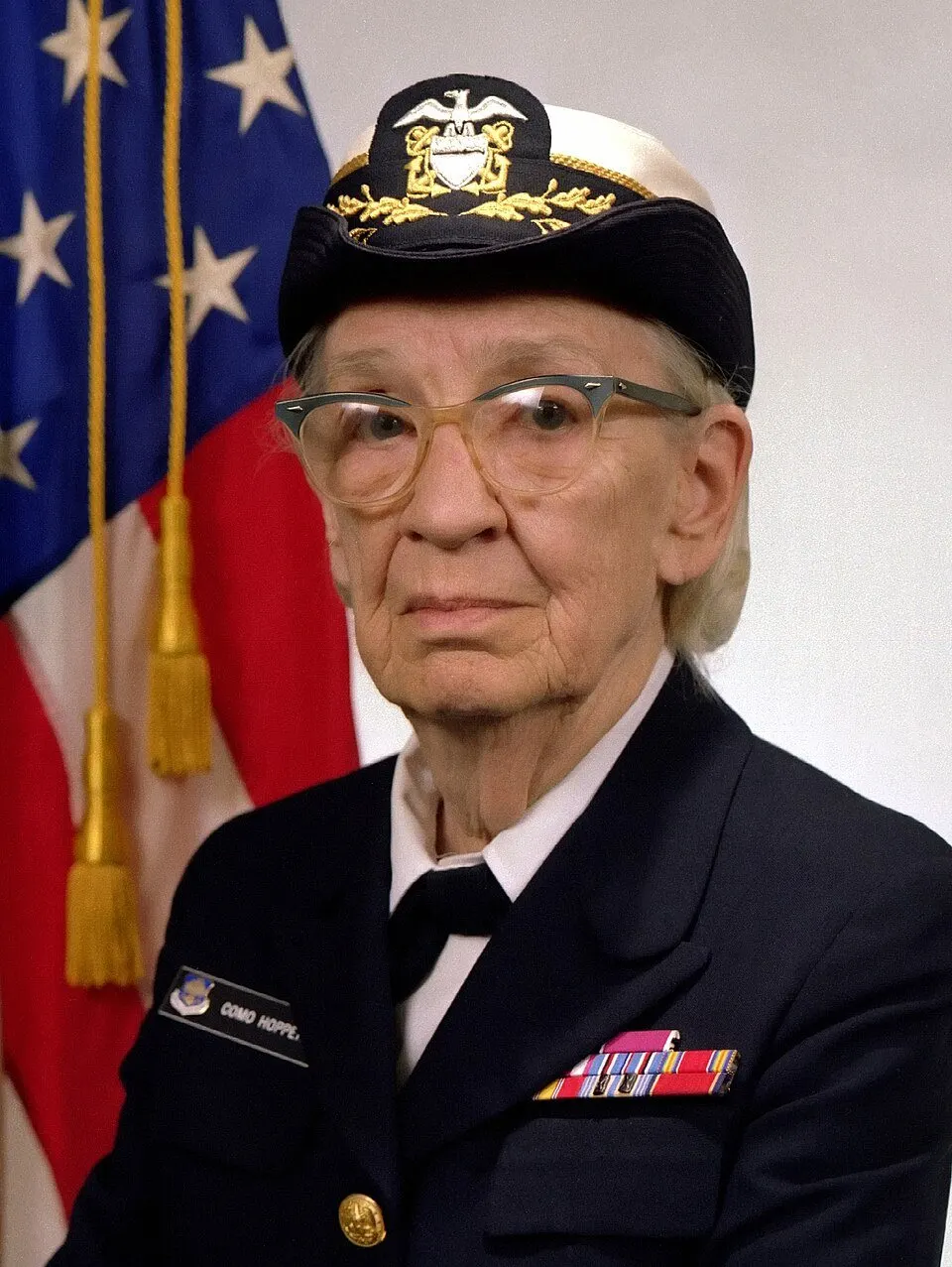
Quick Facts
| Full Name | Grace Brewster Murray Hopper |
|---|---|
| Date of Birth | December 9, 1906 |
| Place of Birth | New York City, New York, United States |
| Date of Death | January 1, 1992 |
| Place of Death | Arlington, Virginia, United States |
| Cause of Death | Natural causes |
| Nationality | American |
| Education | Vassar College (BA), Yale University (MA, PhD) |
| Occupation | Computer scientist, mathematician, United States Navy officer |
| Known For | Developing early compilers, creating FLOW-MATIC, foundational work on COBOL, Harvard Mark I programming |
| Notable Awards | National Medal of Technology (1991), Presidential Medal of Freedom (2016, posthumous), Defense Distinguished Service Medal (1986) |
| Spouse | Vincent Foster Hopper (m. 1930; div. 1945) |
Introduction
Rear Admiral Grace Hopper was a visionary American computer scientist, mathematician, and United States Navy officer whose foundational contributions fundamentally altered how humans interact with machines [1]. At a time when computing required intricate knowledge of hardware and complex binary code, Hopper championed the revolutionary idea that computer programs could be written in human-readable English [1]. Her relentless pursuit of accessible programming led directly to the development of the world's first compilers and laid the groundwork for modern software engineering [1].
Widely celebrated as the "Mother of Computing" and "Amazing Grace," Hopper bridged the gap between academic theory, corporate technology, and military application [1]. Over a career spanning more than four decades, she rose through the ranks of the U.S. Navy to become one of the service's first female flag officers while remaining an indefatigable educator and mentor. Her enduring legacy persists in contemporary software architecture, the widespread adoption of standardized programming languages, and the elevation of women across science, technology, engineering, and mathematics.
Early Life and Family
Grace Brewster Murray was born on December 9, 1906, in New York City [1]. She was the eldest of three children born to Walter Fletcher Murray, an insurance broker, and Mary Campbell Van Horne Murray [1]. Both of her parents possessed strong mathematical and intellectual inclinations; her mother had a keen passion for geometry and mathematics, while her father encouraged his children to be independent, curious thinkers regardless of traditional gender roles.
From an early age, Hopper demonstrated an insatiable curiosity about how mechanical devices functioned. At the age of seven, determined to discover how an alarm clock operated, she dismantled one in her bedroom. When she could not reassemble the intricate springs and gears, she proceeded to take apart six more clocks around the house before her mother discovered the experiment. Rather than punishing her, her mother gently restricted her to a single clock, fostering an environment where analytical inquiry was nurtured. Walter Murray insisted that his two daughters receive the exact same educational and professional opportunities as his son, an attitude that provided Grace with extraordinary confidence during an era of rigid societal expectations for women.
Education
Hopper received her early formal education at the Graham School and later attended the Hartridge School in Plainfield, New Jersey. Dedicated to academic excellence, she applied early to Vassar College but had to wait an extra year after initially failing an entrance exam in Latin. She used that year productively to study and prepare, gaining admission in 1924.
At Vassar College, Hopper excelled in mathematics and physics, earning her Bachelor of Arts degree in 1928 and being elected to the prestigious Phi Beta Kappa honor society. She was awarded a Vassar fellowship to continue her graduate studies at Yale University. In 1930, she earned her Master of Arts degree in mathematics from Yale. That same year, she returned to Vassar as an instructor in mathematics, eventually rising to the rank of associate professor while simultaneously pursuing advanced research.
Under the direction of renowned Norwegian mathematician Øystein Ore, Hopper completed her doctoral dissertation titled New Types of Irreducibility Criteria at Yale University. In 1934, she was awarded her Ph.D. in mathematics, an exceptionally rare achievement for a woman at the time, establishing her credentials as one of the nation's premier mathematical minds.
Career and Major Achievements of Grace Hopper
Grace Hopper’s professional life was a remarkable blend of military service, corporate innovation, and public outreach. Her work guided the electronic computer from an experimental room-sized calculating engine to an essential pillar of global industry.
Joining the Navy and the Harvard Mark I
Following the Japanese attack on Pearl Harbor, Hopper felt a powerful civic duty to serve her country. Initially rejected by the military due to her age (she was 37), her low body weight, and her status as a mathematics professor in a crucial wartime profession, she persistently petitioned for a waiver. In December 1943, she was sworn into the United States Naval Reserve as part of the WAVES (Women Accepted for Volunteer Emergency Service).
After graduating first in her class from the Naval Reserve Midshipmen's School at Smith College in 1944, Hopper was commissioned as a lieutenant (junior grade). She was assigned to the Bureau of Ships Computation Project at Harvard University, under the command of Commander Howard Aiken. There, she became one of the original programmers of the Harvard Mark I (the IBM Automatic Sequence Controlled Calculator), a colossal electromechanical computer designed to calculate artillery firing tables, rocket trajectories, and wartime ballistics. Hopper wrote key operational programs and authored the comprehensive 500-page manual, A Manual of Operation for the Automatic Sequence Controlled Calculator, widely considered the first programming manual in computing history.
Developing the First Compiler and Modern Programming Languages
After the war, Hopper remained at the Harvard Computation Laboratory as a research fellow until 1949, when she transitioned to the private sector by joining the Eckert-Mauchly Computer Corporation as a senior mathematician. Working alongside J. Presper Eckert and John Mauchly, she was tasked with writing software for the UNIVAC I (Universal Automatic Computer), the first commercial electronic computer produced in the United States.
Hopper realized that the greatest bottleneck in computing was not hardware capability, but the tedious, error-prone process of writing machine code by hand. She conceptualized an automated translation system: a program that could convert human-readable mathematical symbols and instructions into raw machine binary. In 1952, she introduced the A-0 system, recognized as the world's first compiler (initially functioning as an automatic linker and loader of subroutines). When she first proposed the idea, peers insisted that computers could only perform calculations, not translate concepts. Hopper proved her critics wrong, publishing seminal papers on automatic programming and paving the way for software automation.
The Birth of COBOL and Standardizing Computing
Hopper continued expanding high-level programming concepts by creating B-0, later known as FLOW-MATIC, in 1955. Unlike previous systems that used mathematical formulas, FLOW-MATIC used plain English commands like COMPUTE, TRANSFER, and COUNT. Hopper correctly predicted that businesses and non-technical personnel needed to understand software logic without mastering advanced mathematics.
Her work with FLOW-MATIC formed the operational foundation for the Conference on Data Systems Languages (CODASYL) in 1959. Hopper served as a crucial technical adviser to the committee that drafted COBOL (Common Business-Oriented Language). Designed as an open, cross-platform language for commercial data processing, COBOL became one of the most widely used programming languages in human history, driving banking, inventory, and administrative systems globally for decades.
A Storied Naval Career and Late-Career Service
Hopper remained an officer in the Naval Reserve while working in private industry. In December 1966, she reached the age limit of 60 and was retired with the rank of commander. However, the Navy quickly recognized that its disparate computing systems required unified standardization. In August 1967, just seven months later, she was recalled to active duty for what was initially planned as a six-month assignment. That assignment lasted nearly two decades.
Hopper took charge of the Navy Programming Languages Group within the Office of Information Systems Planning, working tirelessly to test, calibrate, and enforce programming language standards across the Department of Defense. In 1983, by special presidential appointment, President Ronald Reagan promoted Hopper to the rank of Commodore. When the Navy reformed its flag rank structure in 1985, the title of Commodore was renamed Rear Admiral (lower half). On August 14, 1986, Hopper retired from the U.S. Navy aboard the historic warship USS Constitution at the age of 79. At her departure, she was the oldest active-duty commissioned officer in the United States military.
Awards and Recognition
Grace Hopper received numerous military, academic, and technological honors throughout her lifetime and posthumously:
- Computer Sciences Man of the Year (1969): Awarded by the Data Processing Management Association, marking the first time a woman received this premier industry distinction.
- Defense Distinguished Service Medal (1986): Bestowed upon her final naval retirement, representing the highest non-combat decoration presented by the Department of Defense.
- National Medal of Technology (1991): Awarded by President George H.W. Bush, making Hopper the first individual woman to receive America's highest technology honor.
- Commissioning of USS Hopper (DDG-70) (1997): An Arleigh Burke-class guided-missile destroyer named in her honor, bearing the motto Aude et Effice ("Dare and Do").
- Presidential Medal of Freedom (2016): Awarded posthumously by President Barack Obama, recognizing her extraordinary contributions to science, military service, and the digital era.
- Academic Honors: Conferred more than 40 honorary doctorates from universities around the globe during her long career.
Challenges and Struggles
Hopper's career unfolded against a backdrop of deep institutional skepticism and systemic gender bias. When she sought to enlist during World War II, the Navy initially rejected her because she was 37 years old and weighed just 105 pounds—well below the minimum enlistment threshold of 121 pounds. Furthermore, her teaching position at Vassar was designated as vital to the national interest. It took tremendous determination, political navigation, and formal waivers for her to enter military service.
In the technical arena, Hopper faced fierce pushback from colleagues when proposing automated programming. Many prominent computer scientists of the 1950s scoffed at her claim that machines could translate English commands into code, believing that programming should remain an esoteric specialty practiced only by mathematicians writing raw hexadecimal or octal instructions. She had to independently develop functioning prototypes to dismantle the conventional wisdom of her era.
Her military career also presented hurdles related to rigid age ceilings. She was involuntarily retired from the Navy on multiple occasions due to mandatory retirement statutes, only to be recalled each time because the military realized it lacked personnel with her level of institutional knowledge and technical leadership.
Personal Life
In 1930, Grace Murray married Vincent Foster Hopper, an educator who later became a professor of English and literature at New York University. The couple shared a deep respect for scholarship, but the demands of their respective careers, combined with the disruptions of World War II, led to their amicable divorce in 1945. Vincent Hopper died later that year while serving overseas in the war. Grace Hopper never remarried, retained her married surname for the rest of her life, and had no children.
Hopper was renowned for her dynamic personality, sharp wit, and unpretentious demeanor. A chain-smoker with a dry sense of humor, she possessed exceptional communication skills and loved interacting with young students, junior sailors, and emerging engineers. Her office at the Naval Data Automation Command was famously unconventional; she kept a clock on her wall that ran counter-clockwise to remind staff that standard conventions are not absolute laws of nature.
Death and Legacy
Following her naval retirement in 1986, Hopper refused to withdraw from public life. She immediately joined Digital Equipment Corporation (DEC) as a senior consultant, traveling the country delivering lectures on computer architecture, leadership, and the future of information processing until her final months.
Grace Hopper passed away peacefully in her sleep of natural causes on January 1, 1992, at her home in Arlington, Virginia. She was 85 years old. She was interred with full military honors at Arlington National Cemetery, surrounded by naval officers, colleagues, and admirers.
Today, Hopper is remembered as a pioneering architect of the information age. The annual Grace Hopper Celebration of Women in Computing, established in 1994, has grown into the world's largest gathering of women technologists. In 2017, Yale University renamed one of its undergraduate residential colleges in her honor. Her insistence on intuitive software design directly shaped modern software engineering, ensuring that technology serves people rather than forcing people to think like machines.
Interesting Facts About Grace Hopper
- Popularized the "Computer Bug": On September 9, 1947, while working on the Harvard Mark II, Hopper's team discovered a real moth trapped inside Relay 70 of Panel F. They taped the insect into the laboratory logbook with the notation: "First actual case of bug being found." While the term "bug" already existed in engineering slang, the incident popularized the terms "bug" and "debugging" in computer science.
- The Nanosecond Wire: To explain the physical limits of electronic speed to military officers and politicians, Hopper distributed 11.8-inch pieces of copper wire—the maximum distance an electrical signal can travel through wire in one nanosecond. She often contrasted these with a microsecond (a coil of wire nearly 1,000 feet long) to discourage time-wasting code.
- The Counter-Clockwise Clock: Hopper kept a clock that ran backwards on her office wall to remind visitors that human minds cling to arbitrary habits. Her favorite motto was: "The most damaging phrase in the language is: 'It's always been done that way.'"
- Oldest Active-Duty Officer: When she retired on August 14, 1986, at age 79 years, 8 months, and 5 days, Hopper was the oldest active-duty commissioned officer in the U.S. Navy.
- Late-Night Dismantler: At seven years old, Hopper disassembled seven alarm clocks in her family home before her mother discovered the dismantled parts, sparking a lifelong fascination with mechanical and electrical systems.
- First Individual Woman Awarded the National Medal of Technology: In 1991, President George H.W. Bush presented her with the honor in the White House Rose Garden for her pioneering work in programming language automation.
Frequently Asked Questions
What is Grace Hopper most famous for?
Grace Hopper is best known for developing the first compiler (the A-0 system) in 1952 and creating FLOW-MATIC, the direct precursor to COBOL. She pioneered the idea that programming languages should use plain English words rather than machine code, revolutionizing modern computer science.
Did Grace Hopper invent the word "debugging"?
Hopper did not coin the term "bug"—it had been used in engineering slang since the 19th century. However, she and her team at Harvard popularized the term in computing when they removed a moth from the Harvard Mark II computer in 1947 and taped it into their logbook as the "first actual case of bug being found."
What was Grace Hopper's highest rank in the U.S. Navy?
Hopper attained the rank of Rear Admiral (lower half). She was originally appointed to the flag rank of Commodore by President Ronald Reagan in 1983; this rank was officially retitled Rear Admiral (lower half) by the Navy in 1985.
Why did Grace Hopper hand out pieces of wire?
Hopper handed out 11.8-inch pieces of copper wire to visually demonstrate how far an electrical signal can travel in a single nanosecond (one billionth of a second). It served as a vivid visual aid to teach programmers and military officials why efficient code and proximity in computer hardware mattered.
What was Grace Hopper's role in the creation of COBOL?
While Hopper did not write the final COBOL specification alone, her earlier language, FLOW-MATIC, was the primary blueprint used by the CODASYL committee in 1959. She served as a leading technical adviser, and her principles of business-oriented, English-language coding formed the foundation of the language.
Conclusion
Grace Hopper was a rare polymath whose brilliance transformed mathematical abstractions into practical instruments of modern civilization. Her visionary insistence on machine-independent programming languages dismantled the barriers separating human communication from computer execution, fostering an era of rapid technological expansion. As a naval officer, research mathematician, and relentless innovator, Rear Admiral Grace Hopper exemplified intellectual bravery, proving that the greatest progress begins with daring to question convention.
Image: Wikimedia Commons, via Wikipedia (see the file page for author and license).
More biographies in Tech → · All biographies
Related biographies

Nii Quaynor: Life and Legacy of Africa's Internet Pioneer
Celebrated as the "Father of the Internet in Africa," Dr. Nii Narku Quaynor pioneered digital connectivity across the continent…

Reinhold Messner Biography: Life of the Mountaineering Legend
Discover the life of Reinhold Messner, the mountaineering icon who summited all 14 eight-thousanders and conquered Everest solo…

Kazi Nazrul Islam: Life and Legacy of the Rebel Poet
Kazi Nazrul Islam was a legendary Bengali poet, composer, and freedom fighter who challenged colonial rule and bigotry. Revered…

Irmã Dulce – Life of the Good Angel of Bahia
Revered as the "Good Angel of Bahia," Irmã Dulce built Brazil's largest charitable healthcare network, transforming a convent…
Intizar Hussain Biography: Master Chronicler of Urdu Literature
Explore the life and literary genius of Intizar Hussain, the acclaimed Pakistani novelist whose allegorical fiction captured the…
Amílcar Cabral: Life of the Anti-Colonial Leader & Theorist
Amílcar Cabral led Guinea-Bissau and Cape Verde toward independence from Portuguese rule while crafting seminal theories of…