
Chris Hani: The Life and Legacy of a Liberation Hero
In brief: Explore the biography of Chris Hani, Chief of Staff of Umkhonto we Sizwe and General Secretary of the SACP, whose courageous leadership accelerated South Africa's transition to democracy.
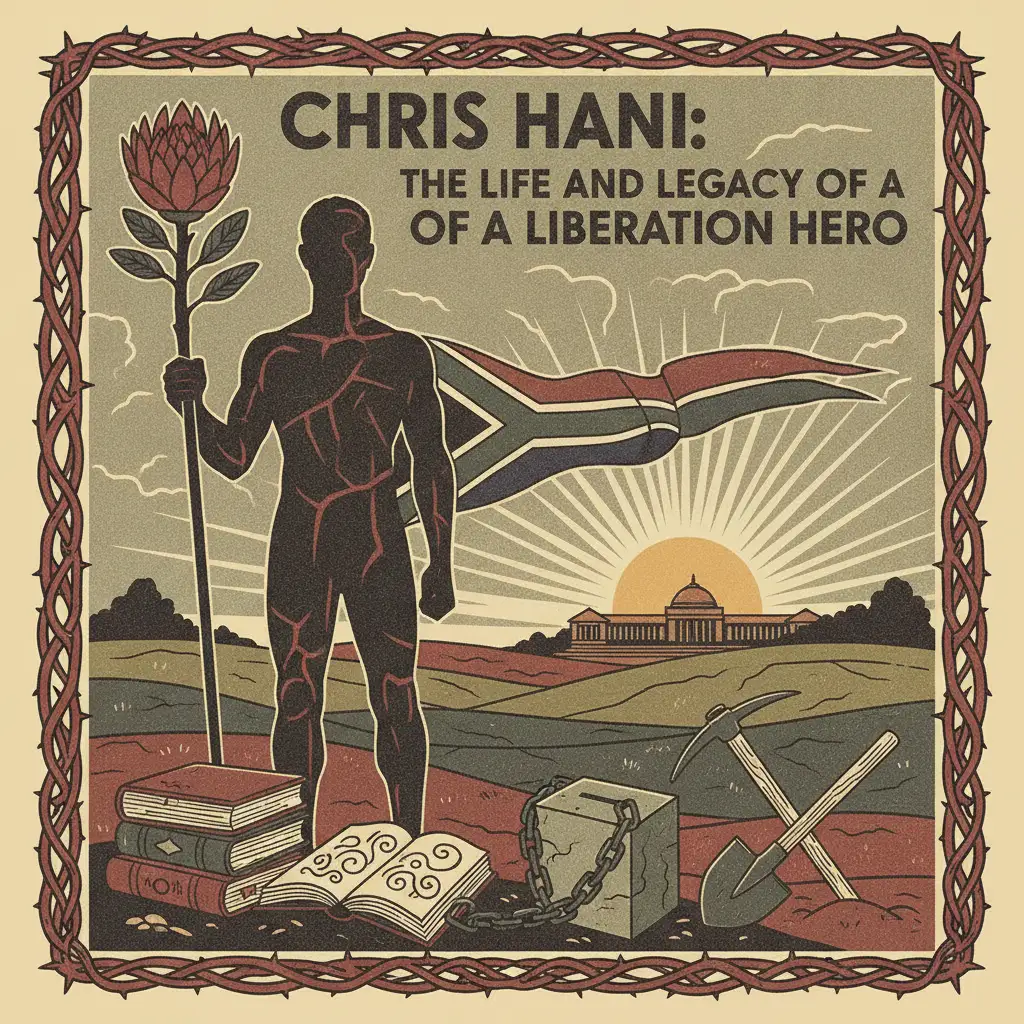
Quick Facts
| Full Name | Martin Thembisile Hani |
|---|---|
| Date of Birth | June 28, 1942 |
| Place of Birth | Cofimvaba, Eastern Cape, South Africa |
| Date of Death | April 10, 1993 |
| Place of Death | Dawn Park, Boksburg, South Africa |
| Cause of Death | Assassination (gunshot wounds) |
| Nationality | South African |
| Education | Lovedale High School; University of Fort Hare; Rhodes University (BA in Latin and English, 1962) |
| Occupation | Revolutionary, military commander, politician |
| Known For | Chief of Staff of Umkhonto we Sizwe, General Secretary of the South African Communist Party, leading anti-apartheid militant |
| Notable Awards | Star of South Africa (Gold), Star for Bravery (Silver), Conspicuous Leadership Star |
| Spouse | Limpho Hani (m. 1974) |
| Children | Neo Hani, Nomakhwezi Hani, Lindiwe Hani |
Introduction
Chris Hani stands as one of the most revered and charismatic leaders in South Africa's long struggle against racial oppression. As the Chief of Staff of Umkhonto we Sizwe (MK)—the armed wing of the African National Congress (ANC)—and later as the General Secretary of the South African Communist Party (SACP), he combined battlefield valor with profound political intellect. Widely considered second in popularity only to Nelson Mandela, Hani gave voice to the aspirations of ordinary workers, youth, and guerrilla combatants who demanded an uncompromising end to white minority rule.
His assassination on Easter Saturday in April 1993 plunged South Africa to the precipice of civil war during a precarious transitional phase. Yet the immense moral authority he had cultivated throughout decades of exile, combat, and underground organizing ultimately helped force the pace of historic negotiations. Hani’s untimely martyrdom broke political deadlocks, compelled the apartheid government to fix a firm date for democratic elections, and cemented his position as an eternal symbol of revolutionary discipline and grassroots justice.
Early Life and Family
Chris Hani was born Martin Thembisile Hani on June 28, 1942, in the rural hamlet of Sabalele, situated near Cofimvaba in the Transkei region of what is now the Eastern Cape. He was the fifth of six children born to Gilbert and Mary Nomayise Hani, growing up in an area characterized by deep poverty and state-enforced neglect. Only three of his siblings survived past infancy, an early confrontation with deprivation that left a lasting impression on the young boy. He later adopted the name "Chris" as a nom de guerre in honor of a beloved brother who had passed away.
Hani’s father, Gilbert Hani, was a migrant worker, mine union activist, and dedicated member of the African National Congress who frequently lived away from home to support his family. His mother, Mary, carried the burden of maintaining subsistence agriculture and managing the household. Watching his mother labor relentlessly while his father faced political victimization by colonial and apartheid authorities radicalized Hani from childhood. He was raised in a devout Roman Catholic environment, serving as an altar boy and developing a deep spiritual awareness that at one stage inspired him to consider the priesthood, an aspiration his father steered him away from in favor of secular academic pursuits.
Education
Hani’s academic journey began in local Roman Catholic mission schools, where he displayed unusual intellect and an affinity for languages. After his father transferred him away from the Catholic seminary track, he attended Matanzima Secondary School in Cala. His political education accelerated during this period; in 1954, several of his teachers were dismissed following their resistance to the apartheid regime's draconian Bantu Education Act. This blatant state interference hardened his resolve to challenge state injustice.
In 1957, Hani enrolled at the prestigious Lovedale High School in Alice, Eastern Cape, a historic institution known for educating generations of African intellectuals. There, he joined the ANC Youth League at age 15, despite the state ban on organized political activity within black secondary schools. After completing his matriculation examinations, he entered the University of Fort Hare in 1959. Fort Hare was a hotbed of anti-colonial consciousness, where Hani immersed himself in Marxism, Latin, English, and classical Greek literature. He completed his studies through Fort Hare and Rhodes University, graduating in 1962 with a Bachelor of Arts in Latin and English. Hani often noted that his deep love for the classics and humanities, rather than distancing him from the plight of the poor, sharpened his rejection of tyranny and human servitude.
Career and Major Achievements
Underground Entry and the Armed Wing
Following his graduation in 1962, Hani moved to Cape Town and became an articled clerk at the law firm Schaeffer and Schaeffer. However, his legal apprenticeship was short-lived. Following the 1960 Sharpeville massacre and the state's subsequent banning of liberation organizations, the ANC and the South African Communist Party resolved that peaceful protests were no longer viable. Hani had already joined the underground SACP in 1961, and in 1962, he formally entered Umkhonto we Sizwe. He was arrested late that year under the Suppression of Communism Act while transporting anti-apartheid pamphlets, receiving a suspended sentence and later facing persistent police surveillance. In 1963, while free on bail pending an appeal, the leadership ordered him to leave the country for military training abroad.
The Wankie Campaign and the Luthuli Detachment
Between 1963 and 1967, Hani received specialized military instruction in the Soviet Union, mastering guerrilla tactics, weapons engineering, and political commissariat functions. His baptism by fire occurred in 1967 during the historic Wankie Campaign in Southern Rhodesia (now Zimbabwe). Serving as the political commissar of the Luthuli Detachment—a joint combat unit formed by MK and the Zimbabwe African People's Union (ZAPU)—Hani helped lead combatants across the Zambezi River into hostile territory.
The unit engaged in fierce battles against combined Rhodesian and South African security forces. Despite extreme conditions, lack of air support, and grueling terrain, Hani demonstrated extraordinary composure and tactical bravery under heavy fire. When the surviving detachment was forced to withdraw into Botswana, Hani was arrested for carrying weapons and served nearly two years in a Botswana prison before returning to the liberation headquarters in Lusaka, Zambia. The Wankie Campaign established Hani's reputation as a frontline commander who refused to ask of his troops what he was unwilling to endure himself.
The Hani Memorandum and Morogoro Conference
In 1969, dismayed by what he perceived as stagnation, bureaucratic complacency, and security lapses among the ANC's exiled leadership, Hani co-authored the famous "Hani Memorandum". The document offered an unvarnished critique of high-ranking officials who lived comfortably abroad while cadres in military camps languished without operational directives. The memorandum generated immediate controversy, and Hani initially faced severe disciplinary threats from the military high command.
Intervention by ANC President Oliver Tambo protected Hani and transformed the crisis into an opportunity for renewal. The concerns raised in the memorandum compelled the ANC to convene the landmark Morogoro Conference in Tanzania in 1969. The conference led to sweeping administrative reforms, re-energized the armed struggle, and opened ANC membership to all South Africans regardless of race, marking a seminal turning point in the organization's history.
Building the Underground and Chief of Staff of MK
In 1974, Hani secretly re-entered South Africa to rebuild underground combat structures and intelligence pipelines inside the country before setting up operational headquarters in Lesotho. For nearly eight years, he ran an extensive network of infiltration routes, political study groups, and logistical networks that funneled thousands of young recruits from the 1976 Soweto Uprising into MK training facilities.
Recognizing his operational brilliance and immense standing among the rank-and-file, the ANC leadership appointed Hani as Deputy Commander of MK and later, in 1987, as MK’s Chief of Staff alongside Commander Joe Modise. Hani oversaw strategic escalations against state installations, military infrastructure, and apartheid security apparatuses. Despite living in the crosshairs of state hit squads, he remained actively engaged with frontline soldiers in Angola, Zambia, and Mozambique, earning their unyielding loyalty.
Leading the South African Communist Party
When the apartheid government unbanned liberation movements in February 1990, Hani returned to South Africa from nearly three decades of exile. While participating in the fragile political transition, he prioritized working-class interests and racial equality. In December 1991, following Joe Slovo's decision to step down due to failing health, Hani was elected General Secretary of the South African Communist Party. Under his charismatic leadership, SACP membership surged to unprecedented heights, as he articulated a vision of democratic socialism that emphasized land redistribution, workers' rights, universal healthcare, and robust education for all citizens.
Awards and Recognition
Chris Hani received extensive civilian and military honors, predominantly bestowed posthumously in recognition of his selfless sacrifice. In independent South Africa, the state conferred upon him high-ranking national orders, including the Star of South Africa (Gold) and the Star for Bravery (Silver). He was also decorated with the Conspicuous Leadership Star and the Decoration for Merit by the South African National Defence Force, acknowledging his foundational role in molding the nation's military heritage.
Across South Africa, Hani's name adorns crucial civic and educational institutions. The former Baragwanath Hospital in Soweto—one of the largest medical complexes on Earth—was renamed the Chris Hani Baragwanath Hospital in his honor. In the Eastern Cape, a massive municipal region encompassing his ancestral home was named the Chris Hani District Municipality. Major universities, including the University of Cape Town and Rhodes University, have dedicated lecture halls, student residences, and academic centers to his memory, preserving his intellectual and revolutionary legacy for future generations.
Challenges and Struggles
Hani’s life was defined by perpetual peril and arduous personal sacrifices. During his decades in exile, he survived multiple assassination attempts orchestrated by the South African Security Police and death squads. In Lesotho, his house was bombed, and car-bomb plots were narrowly averted through vigilance. He endured years in clandestine hiding, separation from his immediate family, and the constant strain of operating under false identities across hostile southern African territories.
Politically, Hani constantly had to balance the intense anger and revolutionary fervor of township youths with the tactical concessions required at the negotiating table. When the ANC suspended its armed struggle in 1990 to enable constitutional negotiations, Hani publicly supported the decision despite reservations among his combatants. He expended enormous energy visiting townships, mines, and rural communities to explain the transition, calm volatile situations, and build community self-defence units (SDUs) to protect unarmed civilians from state-sponsored third-force violence.
Personal Life
In 1974, Chris Hani married Limpho Sekamane, who was herself an activist in the liberation struggle. The couple had three daughters: Neo, Nomakhwezi, and Lindiwe. Because of his underground commitments and the constant threat of security police raids, family life was subjected to intense stress, requiring frequent relocations between Lesotho, Zambia, and Zimbabwe. Nomakhwezi tragically passed away in 2001 at the age of 23.
Despite his commanding military stature, Hani was remembered by friends, family, and comrades as a man of genuine warmth, unpretentious humor, and quiet habits. He retained an insatiable appetite for reading classical poetry, Latin literature, and political philosophy. Colleagues often recalled finding him engrossed in ancient literature late at night in rugged military camps across Angola and Zambia.
Death and Legacy
On the morning of April 10, 1993, Chris Hani stepped out of his home in the racially integrated suburb of Dawn Park, Boksburg, to purchase a newspaper. As he walked up his driveway upon returning, Janusz Waluś, a far-right Polish immigrant associated with extremist neo-apartheid groups, approached and shot Hani four times at point-blank range, killing him instantly. The conspiracy had been orchestrated by Clive Derby-Lewis, a senior member of the right-wing Conservative Party, who had supplied the unlicensed murder weapon.
The killers intended to spark widespread racial violence and derail the ongoing transition toward multiracial democracy. South Africa stood on the brink of an abyss, with violent protests erupting in townships nationwide. In that decisive moment, Nelson Mandela addressed the country on national television, urging calm while delivering a message that acknowledged how an Afrikaner woman neighbor, Margaretha Harmse, had immediately noted the assassin’s license plate and called the police, leading to Waluś’s arrest. Mandela channeled the collective outrage into an unassailable mandate for democracy, demanding that the De Klerk government immediately finalize the date for South Africa's first universal franchise election.
Hani’s sacrifice directly accelerated the birth of the new South Africa, culminating in the democratic election of April 27, 1994. Today, Hani is commemorated not only as a fallen commander, but as the moral compass of the liberation movement—a leader who stood steadfastly with ordinary working-class citizens against corruption, elitism, and economic injustice.
Interesting Facts
- Altar Boy Roots: Hani was an exceptionally devout Catholic in his youth and strongly desired to become a Catholic priest until his father intervened.
- A Classical Scholar: He was deeply versed in Latin and English literature, having earned a university degree majoring in both subjects, and frequently quoted classical poets during political debates.
- A Borrowed Name: His given name was Martin Thembisile; he adopted the nom de guerre "Chris" from his brother who had passed away earlier in life.
- Surviving the River Crossing: During the 1967 Wankie Campaign, Hani led soldiers across the dangerous Zambezi River, facing crocodile-infested waters and enemy ambushes.
- The Hospital Namesake: The Chris Hani Baragwanath Hospital in Soweto, named in his honor, is one of the largest and most famous tertiary healthcare institutions in the world.
- Unarmed on His Final Day: On the morning he was assassinated, Hani had given his armed bodyguards the day off so they could spend Easter weekend with their families.
Frequently Asked Questions
What was Chris Hani's birth name?
Chris Hani was born Martin Thembisile Hani. He adopted "Chris" as a protective military nom de guerre during his early underground years, choosing it in tribute to his late brother.
What role did Chris Hani play in Umkhonto we Sizwe?
Hani joined Umkhonto we Sizwe (MK) in 1962, fought as a combat commissar during the 1967 Wankie Campaign, rebuilt internal underground pipelines, and eventually served as MK's Deputy Commander and Chief of Staff from 1987 until the suspension of the armed struggle.
Who killed Chris Hani and why?
Hani was shot and killed on April 10, 1993, by Janusz Waluś, a radical anti-communist Polish immigrant. The plot was organized by Clive Derby-Lewis, a high-ranking politician in the Conservative Party, with the objective of provoking a race war that would abort negotiations for a democratic South Africa.
How did Chris Hani's death impact South Africa's transition?
Rather than stopping the transition, Hani's murder placed intense public pressure on the apartheid regime. Nelson Mandela harnessed the nationwide outrage to demand that the state immediately schedule South Africa's first non-racial democratic elections, which were subsequently fixed for April 27, 1994.
Conclusion
Chris Hani remains an enduring giant of the South African liberation struggle. A fearless soldier, erudite intellectual, and devoted servant of the working class, he represented the purest ideals of selfless leadership. Though assassins ended his life before he could witness the free, multiracial society he fought so long to create, his blood sealed the victory of democracy over apartheid, making his name synonymous with courage, integrity, and liberation.
More biographies in Militant → · All biographies
Related biographies

Crazy Horse Biography: Life and Legacy of the Lakota War Leader
Crazy Horse was a revered Oglala Lakota war leader whose tactical genius and unyielding defense of indigenous lands culminated in…
Amílcar Cabral: Life of the Anti-Colonial Leader & Theorist
Amílcar Cabral led Guinea-Bissau and Cape Verde toward independence from Portuguese rule while crafting seminal theories of…
Malik Muhammad Saad Khan Shaheed Brave Police Officer
Introduction: A young Malik Muhammad Saad Khan was martyrdom in a suicide attack on 27th January 2007. He martyred while […]
8 Pass Charlie – “An Unsung Hero of Pakistan” – Our National Hero
(Squadron Leader Najeeb Ahmed Khan ‘8 pass charlie‘) Introduction: Date of Birth N/A Date of Death 6th September 1965 Allegiance…
Wanda Rutkiewicz: Life and Feats of a Mountaineering Pioneer
Wanda Rutkiewicz was a visionary Polish climber and engineer who made history as the first European woman on Mount Everest and…

Buzurgmehr Yorov: The Courageous Voice of Tajik Justice
Buzurgmehr Yorov is a prominent Tajik human rights lawyer who championed the rule of law and defended political dissidents in the…