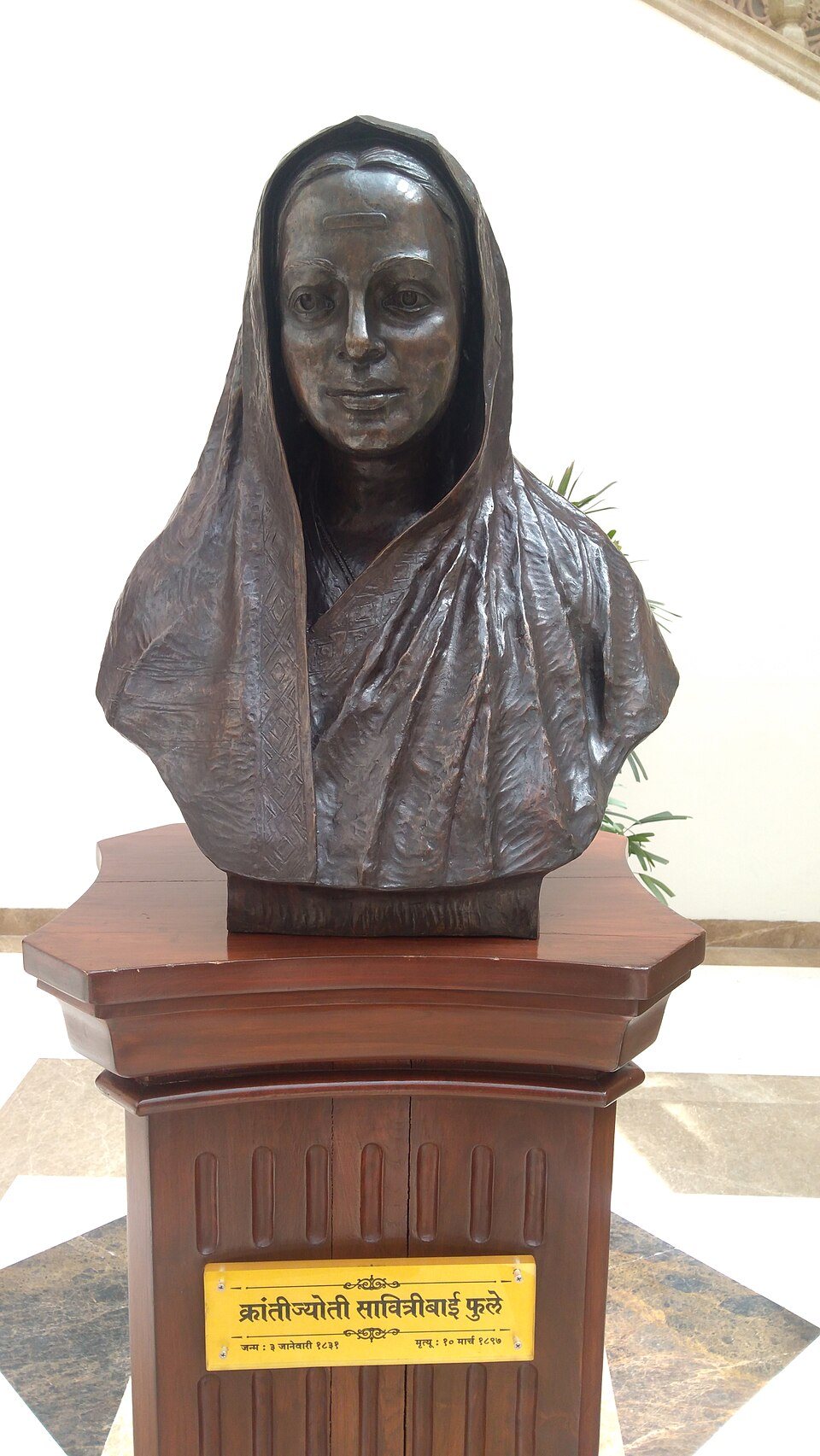
Introduction: Who Was Savitribai Phule?
Savitribai Phule was an Indian educator, social reformer, and poet who transformed the social fabric of nineteenth-century India. Revered as modern India’s first female teacher, she stood at the forefront of the country’s early feminist and anti-caste movements. Alongside her husband, the visionary philosopher Jyotirao Phule, she launched a fierce, lifelong campaign against social stratification, untouchability, and the systemic denial of literacy to women and lower-caste communities.
At a time when patriarchal norms and rigid caste hierarchies barred marginalized groups from learning, Savitribai opened classroom doors to those society sought to exclude. Her radical belief that education constitutes the single most potent instrument for human dignity and liberation spurred the establishment of pioneering schools across Maharashtra. More than a teacher, she was a protector of widows, an organizer of mutual aid societies, and a literary voice whose poetry awakened a generation to civic consciousness.
Early Life and Family of Savitribai Phule
Savitribai Phule was born on 3 January 1831 in the village of Naigaon, situated in the Satara district of Maharashtra, then part of the Bombay Presidency. She was the eldest daughter of Lakshmi and Khandoji Neveshe Patil, who belonged to the agricultural Mali community. During this period, the orthodox social order strictly denied girls formal schooling, meaning young Savitribai spent her early childhood helping her family with domestic and agricultural work without learning to read or write.
In accordance with prevalent cultural customs of child marriage, Savitribai was married in 1840 at around nine or ten years of age to thirteen-year-old Jyotirao Phule. Jyotirao belonged to the same community in Pune and harbored progressive ideals influenced by Western egalitarian thought, rationalism, and anti-caste philosophy. Recognizing his young wife's intelligence, curiosity, and resolute spirit, Jyotirao resolved to guide her path toward literacy and intellectual self-determination.
Savitribai Phule’s Education and Training
Savitribai’s formal educational journey began at home under her husband’s patient tutelage. Jyotirao taught her the Marathi alphabet, arithmetic, and basic reading skills, often sharing books that emphasized universal human rights. Savitribai applied herself diligently, quickly mastering primary lessons and developing a profound passion for learning.
To prepare her to teach others, Jyotirao arranged for her to undergo rigorous pedagogical training. Savitribai enrolled in a teacher-training course at an institution run by American missionary Cynthia Farrar in Ahmednagar. Farrar had successfully operated native schools for girls, and her curriculum offered Savitribai foundational experience in primary school administration, modern instruction, and classroom engagement.
Following her training in Ahmednagar, Savitribai completed an additional course at Ms. Mitchell's Normal School in Pune. This dual preparation turned her into one of the earliest certified female schoolteachers in India. During her training in Ahmednagar, she formed a profound bond with Fatima Sheikh, another pioneering woman who would become her steadfast teaching colleague and ally in the historic social reform campaigns that followed.
Career and Major Achievements of Savitribai Phule
Savitribai Phule dedicated four decades to public instruction, structural reform, and community defense. Her groundbreaking achievements established institutional precedents for universal basic education and female empowerment across South Asia.
Establishing India's First School for Girls at Bhide Wada (1848)
On 1 January 1848, Savitribai Phule, along with Jyotirao and associate Sagunabai Kshirsagar, founded one of India's earliest independent indigenous schools for girls. Situated at the home of Tatyasaheb Bhide in the Bhide Wada neighborhood of Pune, the school began with nine students of varying castes. Savitribai assumed the role of headmistress and principal instructor.
The curriculum departed sharply from traditional rote memorization. Savitribai instituted a progressive syllabus rooted in Western pedagogy, including arithmetic, grammar, natural sciences, and social studies. The revolutionary nature of teaching lower-caste girls arithmetic and analytical sciences shocked the orthodox Brahmin establishment of Pune, yet the school’s academic standard rapidly surpassed that of many colonial boys’ institutions.
Expanding Educational Horizons for Marginalized Communities
Despite relentless community opposition, the Phules expanded their educational mission. By 1851, Savitribai was managing three operational girls' schools in Pune, educating over 150 pupils. Over the course of their careers, the Phules and their allies established approximately 18 schools across the region, catering explicitly to girls and children from Dalit and Shudra communities.
Savitribai understood that social oppression was directly linked to the denial of education. To prevent low attendance caused by economic deprivation, she introduced mid-day incentives, clean drinking water, and stipends for students. She also worked in close collaboration with Fatima Sheikh, offering classes to Muslim and Dalit girls inside the Sheikh family residence when orthodox backlash temporarily forced them from their home.
Founding Balhatya Pratibandhak Griha and Social Welfare Work
Savitribai’s activism quickly extended beyond the classroom walls to address the mortal dangers confronting vulnerable women. In nineteenth-century Maharashtra, orthodox society subjected child widows—especially upper-caste widows—to cruel restrictions, including forced tonsure (head shaving) and severe social isolation. Many widows were subjected to sexual exploitation, and those who became pregnant frequently committed suicide or resorted to infanticide out of desperation.
To confront this humanitarian crisis, the Phules established the Balhatya Pratibandhak Griha (Infanticide Prohibition Home) in 1853. It functioned as a secure shelter where pregnant widows could safely give birth and raise their children, or leave them for adoption without stigma. In addition to founding this home, Savitribai organized a historic barbers' strike in Mumbai and Pune to protest the forced head shaving of widows, challenging systemic ritual humiliation at its source.
Leadership in Satyashodhak Samaj and Literary Contributions
In 1873, Jyotirao Phule established the Satyashodhak Samaj (Truthseekers Society) to eradicate caste hegemony, ritualist exploitation, and idolatry. Savitribai served as a guiding force from its inception, leading the organization's women's wing. Through the society, she instituted simplified wedding ceremonies known as Satyashodhak marriages, which excluded Brahmin priests, dispensed with dowries, and featured egalitarian mutual pledges spoken by the bride and groom.
Savitribai was also an accomplished author and pioneer of modern Marathi literature. She published her first collection of poems, Kavya Phule (Poetry's Blossoms), in 1854, followed by Bavan Kashi Subodh Ratnakar (The Ocean of Pure Gems) in 1892. Using the traditional abhang meter, her verses urged oppressed communities to break the shackles of ignorance through learning, famously writing that education was the true path to human freedom.
Awards and Recognition
Formal state honors in nineteenth-century British India rarely celebrated anti-caste revolutionaries, yet the impact of Savitribai Phule's work garnered official praise during her lifetime and immense national veneration posthumously.
- British Colonial Commendation (1852): In November 1852, the colonial education department recognized Savitribai and Jyotirao Phule at a public felicitation in Pune, honoring her instructional proficiency with a ceremonial shawl and public tribute.
- Commemorative Postage Stamp (1998): India Post issued a commemorative postage stamp featuring her portrait on 10 March 1998 to honor her enduring services to female emancipation.
- Renaming of Savitribai Phule Pune University (2014): The Government of Maharashtra formally renamed the University of Pune as Savitribai Phule Pune University in recognition of her historic educational contributions to the city.
- Balika Din Celebrations: The state of Maharashtra marks her birth anniversary on 3 January annually as Balika Din (Girl Child Day) to promote female literacy and welfare.
Challenges and Struggles Faced by Savitribai Phule
The path Savitribai walked was fraught with severe hostility, social ostracism, and direct physical harassment. In nineteenth-century Pune, education for girls was considered an intolerable violation of ancient religious scriptures and social order. Because Savitribai was a woman from an intermediate caste teaching Dalit girls, she became a primary target of orthodox conservative fury.
During her daily walk from her residence to the school at Bhide Wada, orthodox men lined the streets to verbally abuse her. They hurled stones, mud, cow dung, and rotten fruit at her in an effort to intimidate her into abandoning her work. Undeterred, Savitribai carried a second sari in her bag every morning; upon reaching the schoolroom, she quietly changed into clean clothing and commenced her lessons.
"Sit down to study, cast off ignorance, seize the knowledge of the sciences, and break the bonds of caste oppression."
The opposition did not end on the streets. Orthodox community members exerted tremendous pressure on Jyotirao’s father, Govindrao Phule, threatening the entire family with social boycott and eviction. In 1849, Govindrao felt compelled to expel the couple from the family home. Stripped of financial support and shelter, Savitribai and Jyotirao refused to compromise their work, finding refuge with their friend Usman Sheikh and continuing their mission with uninterrupted resolve.
Personal Life and Partnership with Jyotirao Phule
The bond between Savitribai and Jyotirao Phule represented an unprecedented partnership of intellectual equality, shared purpose, and deep mutual respect. Unlike conventional nineteenth-century marriages, Jyotirao treated Savitribai as an intellectual collaborator and co-leader of their movement.
The couple had no biological children of their own. In 1874, Jyotirao brought home a destitute Brahmin widow named Kashibai, who had arrived at their infanticide prevention home in labor. Savitribai personally nursed Kashibai through childbirth and, alongside Jyotirao, legally adopted the baby boy, naming him Yashwantrao. Despite the extreme social stigma of adopting the child of a Brahmin widow into a non-Brahmin family, they raised Yashwantrao with immense care and financed his education to become a medical doctor.
Death and the Enduring Legacy of Savitribai Phule
Following Jyotirao Phule’s death in November 1890, Savitribai took full charge of the Satyashodhak Samaj. At his funeral, she performed a final act of profound defiance against orthodox tradition: setting aside the patriarchal taboo that prohibited women from performing funeral rites, she personally carried the earthen urn and lit her husband's funeral pyre.
In 1896 and 1897, the worldwide Third Plague Pandemic struck the Bombay Presidency, ravaging the city of Pune. British colonial authorities implemented draconian quarantine policies, leaving destitute and lower-caste victims without access to compassionate medical care. In response, Savitribai and her son, Dr. Yashwantrao Phule, opened a private hospital on the outskirts of Pune to treat plague patients.
Savitribai worked tirelessly in the clinic, feeding and nursing patients personally. In March 1897, she learned of an infected ten-year-old boy named Pandurang Babaji Gaekwad, who had collapsed in the nearby Mahar settlement without aid. Savitribai rushed to his side, hoisted the sick child onto her back, and carried him all the way to the clinic. The close physical contact caused her to contract the virulent disease. Her health deteriorated rapidly, and she died on 10 March 1897 at the age of sixty-six.
Today, Savitribai Phule is celebrated worldwide as a luminary of social justice, educational reform, and intersectional feminism. Her pioneering institutions dismantled the monopoly of privileged castes over literacy, proving that access to knowledge remains the primary catalyst for democratic progress and human liberation.
Interesting Facts About Savitribai Phule
- Two Saris for One Mission: Due to regular assaults with mud and cow dung by orthodox conservatives on her way to work, she routinely carried a spare sari in her bag to ensure she appeared presentable before her students.
- Pioneering Native Woman Principal: At the age of seventeen, when she co-founded the Bhide Wada school in 1848, she became the first indigenous female headmistress in modern Indian history.
- Shattering Funeral Taboos: When Jyotirao died in 1890, Savitribai personally carried the funeral urn and lit his pyre, an act strictly prohibited for women by orthodox Hindu tradition.
- A Voice in Print: Her 1854 poetry collection, Kavya Phule, was published when she was just twenty-three years old, making her one of the earliest published modern Marathi poets.
- First Inter-Caste Adoptive Mother: By adopting Yashwantrao, the child of an unwed Brahmin widow, into their family, she directly challenged conservative bloodline and caste laws.
- Famine Relief Organizer: During the severe famine of 1877, Savitribai established 52 free food distribution centers across Maharashtra to sustain impoverished families.
Frequently Asked Questions About Savitribai Phule
Why is Savitribai Phule recognized as India's first female teacher?
Savitribai Phule completed formal teacher training in Ahmednagar and Pune in the late 1840s and commenced instruction at the Bhide Wada girls' school in Pune on 1 January 1848. This made her the first qualified, indigenous female teacher and headmistress to manage an independent public school for girls in modern India.
What was Bhide Wada, and why is it historically significant?
Bhide Wada was the ancestral residence of Tatyasaheb Bhide in Pune. In 1848, Bhide provided space in his home to Savitribai and Jyotirao Phule to establish their first formal school for girls, defying conservative social boycotts to create a haven for female education.
How did Savitribai Phule contribute to literature?
Savitribai authored two major anthologies of poetry in Marathi: Kavya Phule (1854) and Bavan Kashi Subodh Ratnakar (1892). Her poetry utilized accessible rhyming meters to critique Brahminical supremacy, dismantle untouchability, and advocate for education and self-reliance among working-class communities.
What was the Balhatya Pratibandhak Griha?
Founded in 1853 by the Phules, the Balhatya Pratibandhak Griha was an infanticide prevention home and care sanctuary. It offered safe refuge, maternal healthcare, and child-rearing support to unwed mothers and exploited widows facing severe societal persecution.
Conclusion
Savitribai Phule’s life represents one of the most heroic chapters in the history of global educational reform. Faced with intense social bigotry, familial ostracism, and personal peril, she demonstrated how persistent moral courage can overcome entrenched societal injustice. Through her schools, care homes, and civic organizing, she established that education is not a privilege reserved for the high-born, but an inalienable birthright for every child. Her enduring legacy remains an enduring blueprint for gender equality, social progress, and universal education across India and the world.
Image: Wikimedia Commons, via Wikipedia (see the file page for author and license).