Introduction
Bano Qudsia, revered with warm affection across South Asia as "Bano Aapa," was a monumental luminary of modern Urdu literature. As a prolific novelist, dramatist, and spiritual thinker, she transformed the narrative landscape of twentieth-century Pakistan by intertwining psychoanalysis, existential inquiry, and Eastern spiritual philosophy. Her writings went beyond conventional storytelling, serving as profound explorations into human morality, societal dilemmas, and the enduring yearning of the human soul.
Best remembered for her groundbreaking 1981 novel Raja Gidh and iconic television classics such as Aadhi Baat, Qudsia championed an artistic vision steeped in empathy and moral introspection. Alongside her intellectual partner and husband, Ashfaq Ahmed, she helped nurture generations of readers, thinkers, and playwrights from their literary residence in Lahore. Her decades-long contribution to television, theatre, and Urdu prose established her as an indispensable pillar of Pakistan’s cultural and intellectual heritage.
Early Life and Family of Bano Qudsia
Bano Qudsia was born as Qudsia Chattha on 28 November 1928 in Firozpur, a historic town in eastern Punjab, British India. She belonged to an educated, landowning Muslim Jat family with a deep regard for learning and civic duty. Her father, Chaudhry Badr-uz-Zaman Chattha, was an educated agriculturalist who held a bachelor's degree in agriculture. Tragically, her father passed away while Qudsia was still in her early childhood, leaving the household to navigate considerable emotional adversity.
In the wake of this loss, Qudsia’s mother, Zakira Begum, stepped forward as the guiding force of the family. A pioneering educationalist who served as an Inspector of Schools in British India, Mrs. Chattha instilled in her daughter a disciplined commitment to education and intellectual independence. Qudsia grew up alongside an only brother, Pervaiz Chattha, who went on to become an accomplished painter. Even as a young child in Dharamsala and Firozpur, Qudsia exhibited an instinctive passion for literature, penning short stories as early as class five and entertaining her classmates and teachers with her imaginative narratives.
The defining historical event of her youth came in August 1947 with the Partition of British India. Like millions of families swept up in the geopolitical upheaval, the Chattha family was displaced from their ancestral home and migrated across the border into Lahore, the emerging cultural capital of the new state of Pakistan. The dislocation, personal trauma, and visceral human suffering of Partition left an indelible imprint on her worldview, deepening her sensitivity to human fragility and resilience.
Education
Having completed her initial schooling prior to migration, Qudsia continued her higher education in Lahore at Kinnaird College for Women, one of the premier women's institutions in the region. At Kinnaird, she immersed herself in academic study and began publishing essays and creative pieces in student journals and college periodicals. The rigorous liberal arts environment honed her critical thinking and analytical capabilities.
Recognizing that Urdu was the language through which she could most authentically capture the social ethos and spiritual pulse of the subcontinent, she enrolled at the renowned Government College Lahore (now Government College University) to pursue advanced literary studies. The Department of Urdu at Government College was then a vibrant nexus of creative thought and scholarship. In 1951, she earned her Master of Arts degree in Urdu Literature with academic distinction. Her university years were not only foundational to her literary mastery but also marked the beginning of her lifelong personal and intellectual partnership with fellow writer Ashfaq Ahmed, who was her senior in the department.
Career and Major Achievements of Bano Qudsia
Bano Qudsia’s career spanned over six decades, leaving an enduring imprint on novels, radio plays, stage productions, and Pakistan's golden age of television drama. Her narrative voice combined psychological insight with spiritual philosophy, confronting conventional social hypocrisy with gentle dignity.
Early Literary Endeavors and Magazine Publishing
Upon completing her master's degree, Qudsia threw herself wholeheartedly into creative writing. She contributed short stories to premier Urdu literary journals and collaborated closely with Ashfaq Ahmed on cultural publications. Together, they founded the influential literary magazine Dastango (The Storyteller), which provided a forum for emerging voices and promoted reflective modern Urdu storytelling. Her initial short fiction established her as an observant analyst of domestic relationships, social customs, and the quiet internal conflicts of middle-class households.
Raja Gidh: A Masterpiece of Psychological and Spiritual Fiction
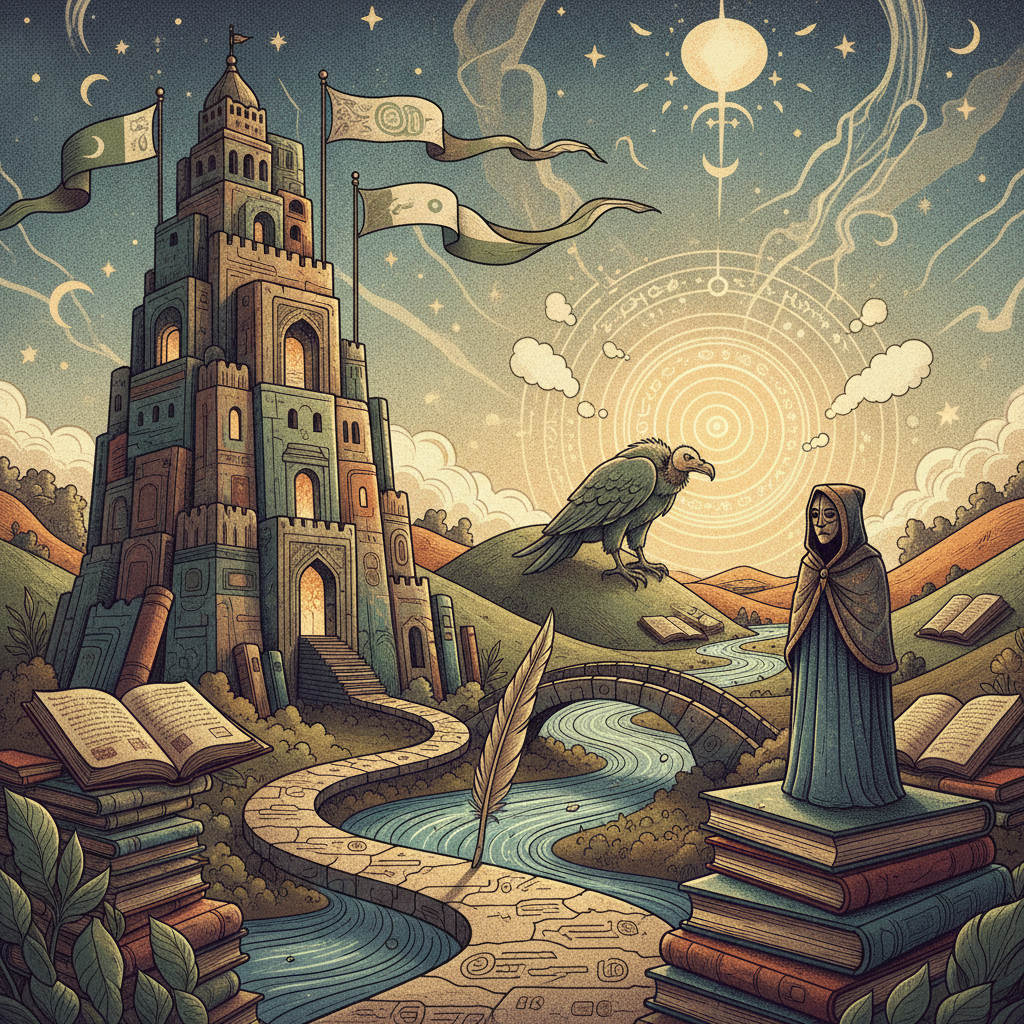
In 1981, Bano Qudsia published Raja Gidh (The King Vulture), a novel that cemented her position among the giants of South Asian literature. The novel unfolds around a tragic love triangle among university students in the Department of Sociology at the University of the Punjab in Lahore, centering on the troubled relationship between Qayyum, Seemi Shah, and Professor Sohail.
Beneath its narrative surface, Raja Gidh is an intricate socio-biological and spiritual allegory. Qudsia employed the metaphor of the vulture—a scavenger that consumes dead flesh—to examine the concept of haram (the forbidden or unlawful). Drawing connections between spiritual transgression and psychological breakdown, she proposed that when human beings persistently pursue forbidden desires or acquire wealth through unjust means, a toxic deterioration sets in, leading to depression, spiritual ruin, and societal madness (janoon). The novel generated immense critical discussion and remains an enduring best-seller, frequently studied in university curricula across the Urdu-speaking world.
Pioneering Dramatist of Pakistan Television
During the 1970s and 1980s, when Pakistan Television (PTV) produced some of the finest serials in Asian broadcasting, Bano Qudsia emerged as one of the medium’s foremost scriptwriters. Writing fluently in both Urdu and Punjabi, she brought authentic domestic realism, sharp dialogue, and profound psychological nuance to television screens.
Her television play Aadhi Baat (The Half-Spoken Truth) is widely celebrated as an all-time classic of Urdu drama. Centered on the psychological loneliness, generational alienation, and quiet dignities of a retired school headmaster, the play explored the unspoken gulfs that exist within everyday family life. Other prominent dramas written by Qudsia include Khaleej, Hawwa Kay Naam, Tamasil, Sehra, and Footpath Ki Ghaas. Her work for broadcasting offered a humane lens on women's suffering, domestic labor, and the social inequalities of contemporary society.
Literary Breadth: Notable Novels and Short Story Collections
Qudsia was exceptionally prolific, authoring dozens of published works that ranged from full-length novels to novelettes and collections of short stories. Among her other acclaimed novels and literary anthologies are:
- Amar Bail: A compelling study of complex human attachments, emotional dependencies, and social expectations.
- Haasil Ghaat: A nuanced exploration of the immigrant experience, generational dislocation, and cultural identity set against Pakistani and Western diasporic realities.
- Aik Din: A vivid portrayal of everyday life, conscience, and ethical decision-making in a rapidly transforming society.
- Chahar Chaman, Chhota Sheher Baray Log, and Aatish-e-Zair-e-Paa: Masterful prose works exploring the friction between modern material ambitions and traditional communal values.
Biographical and Reflective Prose: Raah-e-Rawaan and Mard-e-Abresham
In her later career, Qudsia demonstrated rare brilliance as a biographer and spiritual essayist. Following the death of Ashfaq Ahmed in 2004, his autobiography Baba Saheba remained unfinished. Qudsia completed the second half of the work, publishing it under the title Raah-e-Rawaan (The Flowing Path). The book is both a deeply personal lament and a brilliant study of Ahmed's philosophical worldview, written with candid humor, grief, and intellectual clarity.
She also authored Mard-e-Abresham (The Man of Silk), an insightful biographical work detailing the life and spiritual dimensions of senior bureaucrat, intellectual, and Sufi writer Qudrat Ullah Shahab. Through these reflective prose texts, Qudsia chronicled the spiritual circle that had profoundly shaped Pakistani intellectual life in the latter half of the twentieth century.
Awards and Recognition
Bano Qudsia received numerous national and institutional honors in recognition of her outstanding contributions to Pakistani literature and television. Her prominent awards include:
- Sitara-i-Imtiaz (Star of Excellence): Awarded in 1983 by the Government of Pakistan for her extraordinary contributions to Urdu literature and screenwriting.
- PTV Best Writer Award: Conferred in 1986 in recognition of her critically acclaimed television drama scripts.
- Hilal-i-Imtiaz (Crescent of Excellence): Awarded in 2010 by the Government of Pakistan, representing one of the highest civilian honors for cultural and literary service.
- Kamal-e-Fun Award: Conferred by the Pakistan Academy of Letters (PAL) for the year 2010 (presented in 2012), the highest lifetime achievement award in Pakistani literature.
- Lifetime Achievement Awards: Conferred in 2016 by the Government College University’s Old Ravians Union (GCU-ORU) and the Pakistan Life Care Foundation (PLCF).
Challenges and Struggles
The arc of Bano Qudsia's life was shaped by historical hardship and personal fortitude. The early death of her father placed the family in a vulnerable position during a conservative era, compelling her mother to shoulder the responsibility of raising and educating the children alone. The mass migration during the 1947 Partition forced her family to leave behind their home and economic security, an upheaval that demanded exceptional resilience.
Entering the male-dominated literary establishment of mid-twentieth-century Pakistan presented another significant challenge. While female writers were often expected to restrict their prose to light romance or domestic sentimentality, Qudsia insisted on engaging with heavy metaphysical, philosophical, and societal themes. Her conceptual claims in Raja Gidh—particularly her premise that consuming haram causes genetic and psychological degradation—invited sharp pushback from secular critics and modern sociologists. Qudsia engaged her detractors with characteristic patience, defending her thesis as an artistic and spiritual exploration of the moral universe rather than purely clinical science.
In her later life, the passing of her husband Ashfaq Ahmed in 2004 dealt her an immense personal blow. Despite her grief and deteriorating health in her final decade, she maintained her writing schedule and continued to open her home to young intellectuals seeking guidance.
Personal Life
While studying at Government College Lahore, Qudsia developed a deep intellectual bond with Ashfaq Ahmed. Overcoming initial family reservations rooted in differing ancestral backgrounds—she from a Punjabi Jat family and he from an ethnic Pashtun Mohmand lineage—the two married and built one of South Asia’s most iconic literary partnerships.
The couple had three sons: Aneeq Ahmed Khan, Anees Ahmed Khan, and Aseer Ahmed Khan. Their residence in Model Town, Lahore, named Dastan Sarai (Inn of Stories), became a legendary cultural gathering place. Writers, poets, philosophers, and curious students visited the house to discuss literature, Sufism, and contemporary affairs.
Despite living in complete harmony, Qudsia maintained strict creative independence. She famously emphasized that she and her husband never interfered with or edited each other’s manuscripts, noting that writing was an intimate, sacred communion between the author and God that could not be mediated even by one’s spouse. She balanced the demands of motherhood, domestic hospitality, and a demanding literary career with steady grace.
Death and Legacy of Bano Qudsia
Bano Qudsia passed away on 4 February 2017 at Ittefaq Hospital in Lahore at the age of 88, following an extended period of illness. Her passing triggered widespread mourning across Pakistan and the broader literary world. Funeral prayers were offered at Model Town, Lahore, where she was laid to rest beside her beloved husband. Following her death, the Senate of Pakistan passed a unanimous commemorative resolution honoring her unparalleled services to Urdu letters and national culture.
Her legacy remains profound and enduring. Raja Gidh continues to be read and passionately debated across generations. Her television dramas remain benchmarks for intelligent, socially conscious screenwriting, proving that television can serve as a medium for moral and intellectual elevation. Above all, Bano Aapa is remembered for her gentle philosophy of compassion, forgiveness, and unconditional empathy, leaving behind a body of work that continues to enlighten seekers of ethical truth.
Interesting Facts About Bano Qudsia
- Early Storyteller: She began writing stories in the fifth grade, composing short narratives that she read aloud to entertain her classmates and schoolteachers.
- The Title "Bano Aapa": The honorific suffix "Aapa" (an Urdu term of endearment and respect for an elder sister) was embraced nationwide by literary peers and readers as a reflection of her maternal, compassionate demeanor.
- Strict Artistic Separation: Although she and Ashfaq Ahmed were regarded as an inseparable couple, they wrote completely separately and never shared drafts or advised each other during the composition of their books.
- Cultural Sanctuary at Dastan Sarai: Her Lahore residence was an open salon where eminent literary figures, including Qudrat Ullah Shahab and Mumtaz Mufti, regularly gathered to deliberate on literature and Sufi philosophy.
- Bilingual Playwright: Alongside her mastery of literary Urdu, Qudsia wrote several popular, culturally grounded television dramas in her native Punjabi language.
- Senate Resolution: Following her demise in 2017, Pakistan’s upper legislative chamber, the Senate, formally passed a unanimous tribute praising her lifelong service to the nation’s cultural identity.
Frequently Asked Questions
What is Bano Qudsia best known for?
Bano Qudsia is best known for her classic Urdu novel Raja Gidh (1981), an intricate philosophical and psychological work that examines the consequences of pursuing forbidden desires (haram). She is also widely celebrated for her television dramas, notably Aadhi Baat.
Who was Bano Qudsia married to?
She was married to the renowned Pakistani writer, playwright, and broadcaster Ashfaq Ahmed. The couple met while studying for their master's degrees at Government College Lahore and remained devoted partners until his death in 2004.
What is the core message of Raja Gidh?
The central thesis of Raja Gidh posits that moral transgression—the acquisition or consumption of that which is spiritually and ethically forbidden (haram)—leads to inevitable psychological ruin, anxiety, and social breakdown, mirroring how the vulture is physically confined to scavenging off death.
What major civilian awards did Bano Qudsia receive?
The Government of Pakistan honored her with two of its highest civilian decorations: the Sitara-i-Imtiaz (Star of Excellence) in 1983 and the Hilal-i-Imtiaz (Crescent of Excellence) in 2010. She also received the prestigious Kamal-e-Fun Lifetime Achievement Award from the Pakistan Academy of Letters.
Why was she called "Bano Aapa"?
"Aapa" is a respectful and affectionate Urdu term for an elder sister. It was universally used by generations of readers, actors, and aspiring writers due to her nurturing guidance, wisdom, and warm, welcoming hospitality.
Conclusion
Bano Qudsia holds a permanent place in the pantheon of South Asian literature. Through her novels, plays, and spiritual reflections, she held up a mirror to society's deepest moral anxieties, urging individuals to choose compassion over material greed and inner self-awareness over fleeting vanity. Her enduring body of work continues to instruct, challenge, and comfort readers, ensuring that Bano Aapa’s quiet wisdom will remain a guiding light for generations to come.