
Émile Zola Biography: The Voice of Naturalism and Justice
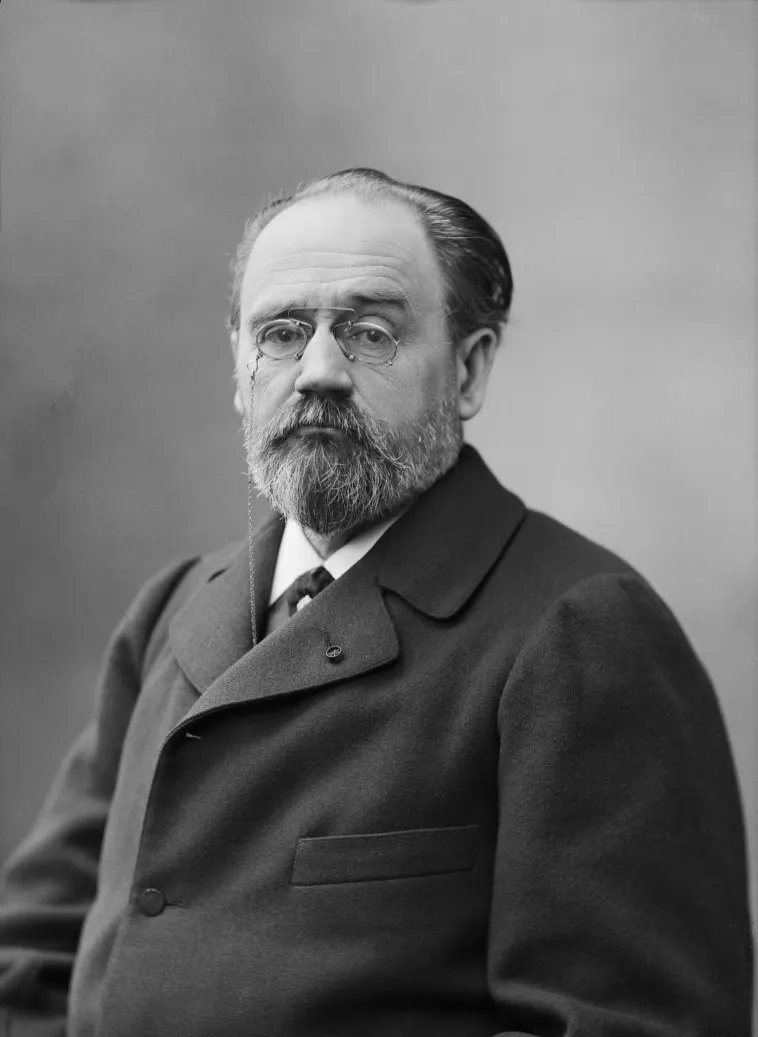
Quick Facts
| Full Name | Émile Édouard Charles Antoine Zola |
|---|---|
| Date of Birth | April 2, 1840 |
| Place of Birth | Paris, France |
| Date of Death | September 29, 1902 |
| Place of Death | Paris, France |
| Cause of Death | Carbon monoxide poisoning |
| Nationality | French |
| Education | Collège Bourbon, Lycée Saint-Louis |
| Occupation | Novelist, journalist, playwright |
| Known For | Les Rougon-Macquart series, "J'Accuse...!", Literary Naturalism, defense of Alfred Dreyfus |
| Notable Awards | Chevalier de la Légion d'honneur (1888), Officier de la Légion d'honneur (1893) |
| Spouse | Alexandrine Meley (m. 1870) |
| Children | Denise Émile-Zola, Jacques Émile-Zola |
Introduction to Émile Zola
Émile Zola stands as one of the towering intellectual and literary giants of modern France. As the principal architect and practitioner of literary naturalism, he reshaped the art of the novel by applying scientific observation, sociology, and medical inquiry to human behavior and society. Over the course of four decades, Zola produced an extraordinary body of fiction, journalism, and theatrical drama, capturing both the opulence of the Second French Empire and the crushing hardships endured by industrial laborers, peasants, and the urban poor.
Beyond his literary accomplishments, Zola earned global renown as an unyielding champion of civil rights and ethical integrity. At the absolute height of his fame and financial security, he placed his reputation, freedom, and fortune on the line to expose high-level military malfeasance and antisemitism during the Dreyfus affair. His courageous open letter, "J'Accuse...!", transformed the social and political landscape of the French Third Republic, establishing the standard for the modern public intellectual and affirming truth and justice as values that transcend personal safety.
Early Life and Family
Émile Édouard Charles Antoine Zola was born on April 2, 1840, in Paris on the Rue Saint-Joseph. He was the only child of François Zola (originally Francesco Zola), an Italian civil engineer and former artillery officer born in Venice, and Émilie Aubert, a native of the Beauce region of north-central France. In 1843, François Zola relocated the family southward to Aix-en-Provence after obtaining the concession to construct a major municipal canal project, which was subsequently named the Canal Zola.
Tragedy struck the family early. In March 1847, when Émile was merely seven years old, his father died suddenly of pneumonia contracted while supervising work on the canal. François Zola left behind massive commercial liabilities, leaving Émilie and her young son in severe financial distress. The young Zola spent the remainder of his boyhood in Aix-en-Provence under the dark shadow of encroaching poverty, an experience that introduced him to the precariousness of social standing and fueled his lifelong empathy for the economically marginalized.
Education and Formative Influences
Zola began his formal schooling at the pension Notre-Dame before transferring to the Collège Bourbon (now the Lycée Mignet) in Aix-en-Provence. Despite early academic hesitation, he flourished in literature and classical humanities. During these formative school years, Zola formed a passionate, inseparable friendship with the future Post-Impressionist painter Paul Cézanne and their classmate Baptistin Baille. The three youths spent endless afternoons hiking through the rugged countryside of Provence, discussing Romantic poetry, debating philosophy, and dreaming of artistic glory.
In 1858, his mother moved to Paris in hopes of securing financial assistance from family connections, and Zola joined her soon after. He was enrolled at the prestigious Lycée Saint-Louis on a scholarship. The stark transition from the sunny landscapes of Provence to the damp, gray poverty of Paris triggered deep melancholy. In 1859, Zola failed the oral examination for the French baccalauréat twice—first in Paris and again in Marseille. Devoid of academic credentials, he found himself cut off from prestigious university tracks and plunged into the underclass of bohemian Paris. He spent two desperate years enduring near-starvation in garrets, working menial jobs while reading voraciously and teaching himself the craft of commercial journalism and fiction.
Career and Major Achievements of Émile Zola
The Emergence of Naturalism and Early Fiction
In March 1862, Zola secured an entry-level position in the shipping department of the esteemed publishing house Louis Hachette. Recognizing his literary flair, his employers soon promoted him to lead the firm's press and publicity department. This position proved pivotal: it provided Zola with steady wages, direct access to prominent Parisian literary figures, and invaluable insight into the machinery of mass-market publication. While working at Hachette, he published his first collection of short stories, Contes à Ninon, in 1864.
A year later, Zola brought out his autobiographical novel La Confession de Claude (1865), which touched upon taboo themes of prostitution and poverty. The work attracted police scrutiny, prompting his resignation from Hachette so he could pursue freelance journalism and literature full-time. In 1867, Zola shocked the Parisian reading public with Thérèse Raquin, a chilling study of murder, adultery, and physiological guilt. In the preface to its second edition, he explicitly embraced the term "naturalism," articulating a literary method that treated human characters not as creatures of pure moral free will, but as living organisms driven by temperaments, nervous systems, and environmental heredity.
The Epic Scope of the Rougon-Macquart Cycle
Inspired by Honoré de Balzac's La Comédie humaine and informed by the medical treatises of Claude Bernard and the evolutionary theories of Charles Darwin, Zola devised an ambitious literary enterprise in 1868. His goal was to chronicle the "natural and social history of a family under the Second Empire" across multiple generations. The resulting series, known as Les Rougon-Macquart, spanned twenty novels published between 1871 and 1893, representing one of the greatest sustained achievements in world literature.
The cycle traced the dual branches of a single family tree, demonstrating how hereditary physical traits and sociological conditions shaped individuals across every layer of French society. Zola conducted meticulous field research for every project, venturing into Parisian slums, coal mines, department stores, and railway yards to document technical vocabulary and living conditions. Among the series' definitive masterpieces were:
- L'Assommoir (1877): A searing, ground-breaking tragedy depicting the working-class scourge of alcoholism and economic destitution, which turned Zola into an international celebrity and a wealthy author.
- Nana (1880): A provocative exposure of high-society decadence and moral decay through the trajectory of an elite Parisian courtesan.
- Germinal (1885): Widely regarded as his crowning masterpiece, a monumental portrait of a miners' strike in northern France that illuminated class struggle, labor rights, and the brutal costs of industrial capitalism.
- La Bête humaine (1890): A psychological thriller combining hereditary homicidal madness with the relentless mechanics of modern railway transportation.
- La Débâcle (1892): An unflinching, graphic examination of France's humiliating defeat in the Franco-Prussian War and the subsequent Paris Commune.
By the time Zola concluded the series in 1893 with Le Docteur Pascal, the Rougon-Macquart had irrevocably altered realistic fiction, validating naturalism as a dominant European literary current.
The Thunderclap of "J'Accuse...!" and the Dreyfus Affair
In 1894, Captain Alfred Dreyfus, an Alsatian Jewish artillery officer in the French Army, was wrongfully convicted of high treason for allegedly leaking military secrets to Imperial Germany. Dreyfus was degraded before howling mobs and banished to Devil's Island. Even after Lieutenant Colonel Georges Picquart uncovered undeniable proof that the real culprit was Major Ferdinand Walsin Esterhazy, the French military high command orchestrated a brazen cover-up to shield the army's reputation, culminating in Esterhazy's swift acquittal by a court-martial in early January 1898.
Outraged by the blatant miscarriage of justice, Zola intervened decisively. On January 13, 1898, the daily newspaper L'Aurore, edited by Georges Clemenceau, splashed Zola's four-thousand-word open letter across its front page under a giant banner headline suggested by Clemenceau: "J'Accuse...!" Addressed directly to Félix Faure, President of the French Republic, the letter systematically accused named military officers, judges, and handpicked handwriting experts of manufacturing evidence, perjuring themselves, and concealing the truth to protect an anti-Semitic agenda.
"Truth is on the march, and nothing shall stop it."
Zola's deliberate strategy was to invite criminal prosecution so that the suppressed military evidence could be evaluated in an open civil courtroom. The publication rocked French society, dividing the country into warring factions of Dreyfusards (republicans, liberals, intellectuals) and anti-Dreyfusards (monarchists, clericalists, militarists, nationalists). Put on trial for criminal libel in February 1898, Zola faced virulent street mobs shouting anti-Semitic obscenities and death threats. Convicted and sentenced to the maximum penalty of one year's imprisonment and a fine of 3,000 francs, he appealed. When a second trial reaffirmed his conviction in July 1898, he acted on the urgent advice of his counsel and fled secretly to England.
Later Literary Cycles and Social Advocacy
During his eleventh-month exile in England, primarily residing in Surrey and London under assumed names, Zola continued writing tirelessly. He had previously published Les Trois Villes (The Three Cities trilogy: Lourdes, Rome, Paris, 1894–1898), which examined spiritual disillusionment and religious dogma. In exile, he plunged into a visionary new quartet titled Les Quatre Évangiles (The Four Gospels), consisting of Fécondité (1899), Travail (1901), and Vérité (published posthumously in 1903). The final volume, Justice, remained unwritten at the time of his death.
Zola returned to France in June 1899 after the French Court of Cassation quashed the original military verdict against Dreyfus, ordering a retrial. Although Dreyfus was absurdly reconvicted "with extenuating circumstances" in Rennes before receiving a presidential pardon later that year, Zola's fearless intervention had broken the conspiracy of silence, setting into motion events that finally led to Dreyfus's complete military rehabilitation and exoneration in 1906.
Awards and Recognition
Zola's artistic triumphs brought him substantial professional influence. In 1888, the French state appointed him a Chevalier of the Legion of Honour (Chevalier de la Légion d'honneur). Five years later, on July 13, 1893, he was promoted to the rank of Officer (Officier). In 1891, he was elected president of the influential authors' guild, the Société des Gens de Lettres, serving until 1894 and spearheading international copyright treaties and stronger legal protections for authors.
However, official recognition was repeatedly thwarted by conservative institutions. Between 1890 and 1897, Zola mounted twenty-four separate candidacies to enter the prestigious Académie française; every bid was rejected by conservative academicians scandalized by his raw realism and controversial social positions. Following his criminal conviction for "J'Accuse...!" in 1898, the government suspended him from the Legion of Honour. In 1901 and 1902, Zola was nominated for the newly established Nobel Prize in Literature, though the Swedish Academy passed over him, uncomfortable with his naturalist candor.
Challenges and Struggles
Zola's entire life was defined by fierce conflict against societal complacency and institutional hostility. In his youth, he struggled with agonizing poverty, pawning his clothes to buy candles and subsisting on bread dipped in olive oil. When he broke through as an author, critics routinely denounced his books as vulgar, pornographic, and depraved, accusing him of dragging French literature into the gutter. His English publisher, Henry Vizetelly, was prosecuted and imprisoned in London simply for printing translated editions of Zola's novels.
The Dreyfus affair brought personal peril on an unprecedented scale. Hostile crowds burned Zola in effigy, smashed windows at his Paris residence, and sent constant death threats. Longtime friends broke relations with him; the painter Edgar Degas and childhood companion Paul Cézanne severed ties over political and cultural divisions. The state ordered the seizure and auction of Zola's personal furniture to pay court fines, an outcome averted only when friends intervened to purchase the items back. Yet through all this, Zola remained unyielding, writing that he accepted the wrath of the mob as the price of a clear conscience.
Personal Life and Relationships
In 1870, Zola married Éléonore-Alexandrine Meley, who had been his companion through his leanest years. Alexandrine was an intelligent, devoted partner who managed his household, organized his working life, and offered unwavering emotional support. The couple lived in their country estate in Médan, outside Paris, where Zola hosted naturalist protégés including Guy de Maupassant and Joris-Karl Huysmans. However, their union remained childless, an enduring source of private grief for Zola.
In 1888, when Zola was forty-eight, he fell deeply in love with Jeanne Rozerot, a twenty-one-year-old seamstress who had joined the household staff. Zola established Jeanne in a separate residence in Paris and fathered two children with her: Denise (born in 1889) and Jacques (born in 1891). When Alexandrine discovered the liaison in late 1891, the marriage suffered a profound crisis. Nevertheless, Alexandrine ultimately chose to remain with Zola and reconciled with the reality of his second family. Following Zola's death, Alexandrine demonstrated extraordinary magnanimity by officially granting Denise and Jacques the legal right to bear the family name Émile-Zola.
Death and Enduring Legacy of Émile Zola
On the morning of September 29, 1902, Émile Zola died at his Paris townhouse on the Rue de Bruxelles at the age of sixty-two. He and Alexandrine had returned from their country estate the prior evening. Unbeknownst to them, the bedroom fireplace flue was blocked, causing lethal carbon monoxide fumes to flood the room while they slept. Alexandrine was discovered unconscious and survived after medical treatment, but resuscitation attempts for Zola failed. While the official inquest declared the tragedy an accidental asphyxiation, rumors persisted for decades that the chimney had been sabotaged by fanatical anti-Dreyfusards, a theory reinforced in 1953 when a Parisian newspaper published claims that a right-wing chimney sweep had confessed on his deathbed to blocking the flue.
Zola's funeral on October 5, 1902, drew vast crowds of admirers, workers, miners, and intellectuals. Alfred Dreyfus marched in the funeral procession. Delivering the memorial address, the acclaimed writer Anatole France offered an immortal epitaph:
"Envy him: he honored his country and the world through his immense work and great action. Envy him, his destiny and his heart achieved the grandest fate: he was a moment of the human conscience."
On June 4, 1908, France bestowed its highest national honor upon Zola by transferring his remains to the Panthéon in Paris, where he was entombed alongside Victor Hugo and Alexandre Dumas. During the ceremony, an anti-Dreyfusard journalist attempted to assassinate Alfred Dreyfus, firing shots and wounding him in the arm, a vivid testament to the lasting passions Zola had confronted. Today, Zola is celebrated worldwide as the master of literary naturalism and the timeless archetype of the courageous intellectual who speaks truth to power.
Interesting Facts About Émile Zola
- Failed Examinations: Despite becoming one of the most prolific and celebrated authors in French history, Zola failed his secondary school baccalauréat exams twice and never earned a formal university degree.
- A Famous Childhood Pact: Zola was the childhood best friend of the Post-Impressionist master Paul Cézanne in Aix-en-Provence; Zola originally championed modern painting and defended Édouard Manet against hostile conservative art critics.
- A Record for Academic Rejections: Driven by principle and stubbornness, Zola put forward his candidacy for the prestigious Académie française twenty-four times, failing every single bid due to conservative opposition.
- Meticulous Research Methods: Before writing Germinal, Zola spent weeks in the northern French coal-mining town of Anzin, donning miners' clothes, descending deep into subterranean pits, and interviewing striking families to capture the authenticity of their lives.
- Passionate Photographer: In his final decade, Zola became an avid photographer, developing hundreds of high-quality glass plates documenting his children, domestic life, and his travels during his exile in England.
- Miners' Chant at His Funeral: During his funeral procession in Paris, a delegation of coal miners marched behind his hearse chanting "Germinal! Germinal!" in tribute to the voice he had given to their struggles.
Frequently Asked Questions About Émile Zola
What is Émile Zola best known for?
Émile Zola is best known as the pioneer of naturalism in literature and the author of the monumental twenty-novel cycle Les Rougon-Macquart, which includes classics such as Germinal, L'Assommoir, and Nana. In world history, he is equally renowned for his open letter "J'Accuse...!", which defended Alfred Dreyfus and exposed military corruption in France.
Why was "J'Accuse...!" such a historic document?
Published on January 13, 1898, "J'Accuse...!" was a watershed moment because a famous civilian author directly denounced senior military officials and government ministers for treasonous corruption, antisemitism, and perverting justice. It forced the reopening of the Dreyfus case and crystallized the modern concept of the intellectual as a public moral conscience.
What was Émile Zola's relationship with Paul Cézanne?
Zola and Cézanne were intimate childhood friends in Aix-en-Provence. Zola introduced Cézanne to Parisian artistic circles and supported him financially during his early struggles. However, their relationship deteriorated in 1886 after Zola published L'Œuvre (The Masterpiece), a novel featuring a tortured, failed genius painter whom Cézanne believed was modeled unflatteringly on himself.
Did Émile Zola ever win the Nobel Prize in Literature?
No, Zola never won the Nobel Prize. He was formally nominated for the first two prizes in 1901 and 1902. The inaugural prize in 1901 was awarded to fellow French writer Sully Prudhomme, as the Nobel Committee favored traditional idealism over Zola's unvarnished naturalism.
How did Émile Zola die, and was it foul play?
Zola died on September 29, 1902, in his Paris bedroom from carbon monoxide poisoning caused by a blocked chimney flue. While the official verdict was accidental asphyxiation, lingering suspicions remain that anti-Dreyfusard extremists intentionally blocked the chimney from the roof to assassinate him.
Conclusion
Émile Zola transformed literature into an uncompromising instrument for examining social truth. Through his groundbreaking naturalism, he gave indelible voice to the working poor, exposed systemic institutional decay, and widened the boundaries of realistic fiction. When history demanded moral courage, he abandoned the comfort of literary fame to defend an innocent man against state corruption and bigotry. In life and legacy, Zola proved that the power of the written word, when wielded in the service of justice, can overturn empires and awaken the conscience of humanity.
Image: Wikimedia Commons, via Wikipedia (see the file page for author and license).
More biographies in Writer → · All biographies
Related biographies
Kazi Nazrul Islam: Life and Legacy of the Rebel Poet
Kazi Nazrul Islam was a legendary Bengali poet, composer, and freedom fighter who challenged colonial rule and bigotry. Revered…
Louis Braille: The Inventor Who Unlocked Literacy for the Blind
Louis Braille transformed life for millions of visually impaired people by creating the six-dot tactile code that unlocked…
Ousmane Sembène Biography: Life of the Father of African Cinema
Ousmane Sembène was a visionary Senegalese author and filmmaker hailed as the father of African cinema. Through landmark works…
Ybyrai Altynsarin: Pioneer of Modern Kazakh Secular Education
Explore the inspiring life of Ybyrai Altynsarin, the 19th-century educator who established Kazakhstan's first secular and girls'…
Talaat Harb – Pioneer of Egypt's Modern Economy
Revered as the father of Egypt's modern economy, Talaat Harb broke foreign financial domination by founding Banque Misr and…
Chung Ju-yung Biography: Founder of Hyundai and Industrial Pioneer
Rising from rural poverty, Chung Ju-yung founded Hyundai, drove South Korea's post-war economic modernization, and orchestrated…