
Intizar Hussain Biography: Master Chronicler of Urdu Literature
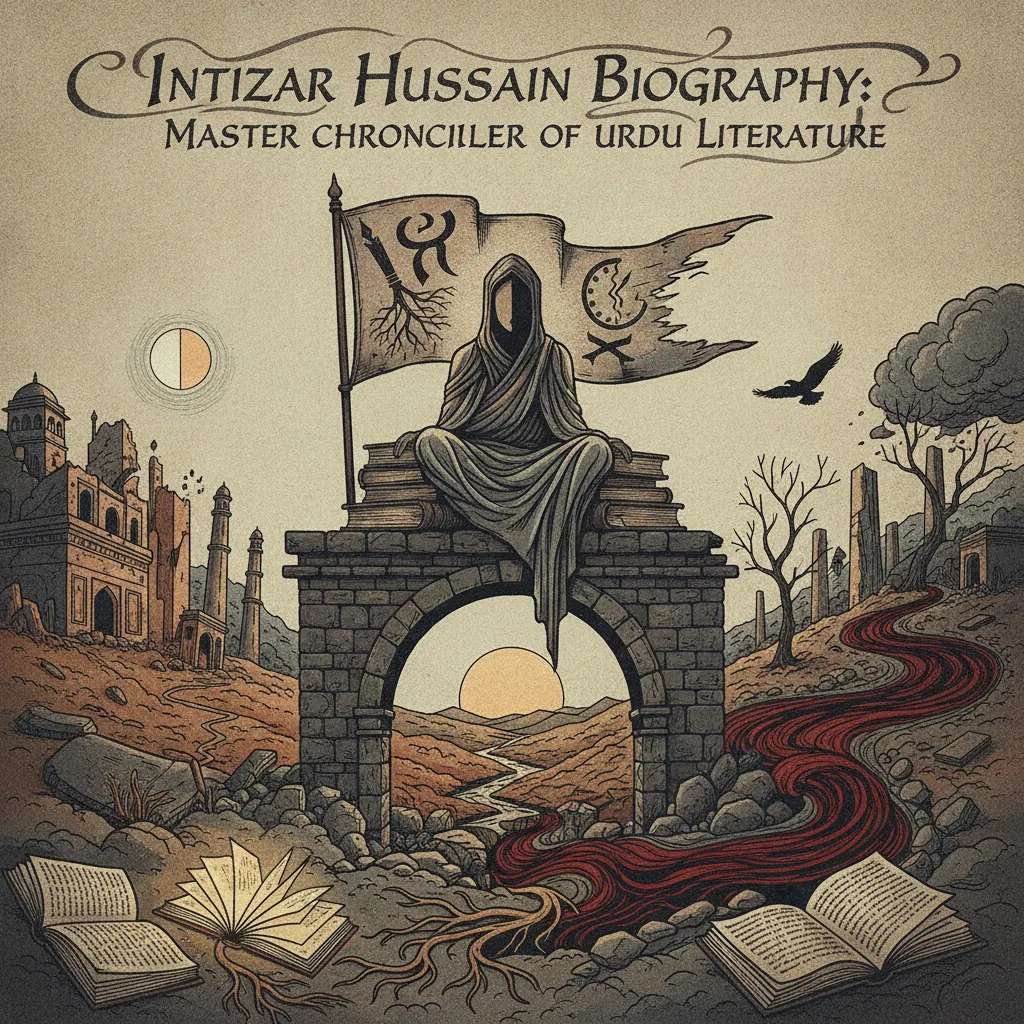
Quick Facts
| Full Name | Intizar Hussain |
|---|---|
| Date of Birth | December 7, 1923 |
| Place of Birth | Dibai, Bulandshahr District, United Provinces, British India |
| Date of Death | February 2, 2016 |
| Place of Death | Lahore, Punjab, Pakistan |
| Cause of Death | Pneumonia |
| Nationality | Pakistani |
| Education | Meerut College |
| Occupation | Novelist, short story writer, columnist, translator |
| Known For | Basti, Aage Samandar Hai, mythological allegories, chronicling Partition |
| Notable Awards | Sitara-e-Imtiaz, Kamal-e-Fun Award, Pride of Performance, Officier de L'Ordre des Arts et des Lettres, Premchand Fellowship |
| Spouse | Aliya Begum |
Introduction
Intizar Hussain stands as one of the most distinguished, transformative voices in modern Urdu literature. Over a prolific writing career spanning nearly seven decades, he elevated the Urdu short story and novel to international prominence by synthesizing classical Eastern narrative traditions with the modern psychological novel. Hussain was a chronicler of moral history, cultural dislocation, and existential memory. Unlike many contemporaries who approached the traumas of the 20th century through straightforward political ideology or documentary realism, he explored the profound ruptures of human civilization through allegory, folklore, and myth.
His towering achievement lies in his ability to articulate the psychic shock of the 1947 Partition of the Indian subcontinent without resorting to sectarian bitterness or graphic sensationalism. Through masterpieces such as Basti and Aage Samandar Hai, Hussain mapped the landscape of migration (hijrat), exploring what was lost in the fracturing of a shared cultural cosmos. In 2013, he achieved unprecedented global recognition when he became the first Pakistani writer—and the first author writing primarily in Urdu—to be shortlisted for the Man Booker International Prize, confirming his place among the giants of world literature.
Early Life and Family of Intizar Hussain
Intizar Hussain was born in Dibai, a modest town in the Bulandshahr district of the United Provinces (present-day Uttar Pradesh), British India. Although Hussain himself noted with dry wit that official records differed on his exact birth date—oscillating between 1922, 1923, and 1925—most archival records and literary biographers cite December 7, 1923, as his birth date. He grew up in an environment steeped in traditional religious scholarship and communal storytelling. His father, Manzar Ali, was an orthodox religious scholar whose instruction laid the foundation for Hussain’s lifelong familiarity with classical texts and traditional Arabic and Persian linguistic aesthetics.
Hussain’s ancestral surroundings were marked by a syncretic cultural tapestry where Hindu, Buddhist, and Islamic folk memories coexisted side by side. As a young boy, he listened to itinerant storytellers, family elders, and neighbourhood gatherings recounting the grand romances of Dastan-e-Amir Hamza, the parables of the Alf Laila (Arabian Nights), and local village folklore. Later in his childhood, his family relocated to the larger market town of Hapur, where he received formal schooling and observed the subtle erosion of rural community life before the advance of modernization. This childhood reservoir of memories, aromas, religious gatherings, and folk idioms became the foundation for his creative universe.
Education
After completing his early secondary schooling in Hapur, Hussain moved to the historic cantonment city of Meerut to pursue higher education. He enrolled at Meerut College, an influential academic hub of northern India that attracted many aspiring intellectuals and political minds. In 1942, Hussain passed his intermediate examinations, proceeding to earn his Bachelor of Arts degree in 1944. Determined to continue his studies despite the financial strains on his household, he worked modest clerical jobs in Meerut to pay his tuition fees.
Hussain completed his Master of Arts in Urdu literature at Meerut College in 1946. During these formative collegiate years, his intellectual circle included aspiring writers and critics such as Saleem Ahmed and Jamil Jalibi. His academic coursework exposed him to the structural evolution of Urdu poetry and prose, but he also read widely in English literature, Western critical theory, and world drama. When the cataclysm of communal violence erupted in 1947, Hussain’s academic trajectory and plans for competitive civil services were abruptly interrupted, forcing him to confront a historic crossroads.
Intizar Hussain’s Career and Major Achievements
Early Career, Migration, and the Lahore Literary Sphere
In the autumn of 1947, Intizar Hussain made the momentous decision to migrate across the new border to Pakistan, arriving in Lahore—a city that would become his home for the remainder of his life. In those chaotic early months, literary critic Muhammad Hasan Askari introduced him to influential circles, and Hussain found editing work with literary magazines, including the Lahore edition of Nizam. Soon after, he secured a position at the progressive daily newspaper Imroze, founded under the editorship of the legendary poet Faiz Ahmad Faiz.
Hussain immersed himself in Lahore’s vibrant teahouse culture, becoming a daily patron of the famous Pak Tea House, Nagina Bakery, and Coffee House. During the 1950s, Urdu literature was sharply polarized between the Marxist-oriented Progressive Writers' Association and the modernist, aesthetic-driven circle known as Halqa-e-Arbab-e-Zauq. While Hussain maintained close personal ties with luminaries on both sides, he refused to subordinate his artistic independence to ideological manifestos. He affiliated primarily with the aesthetic sensibilities of Halqa-e-Arbab-e-Zauq, developing a unique style of prose that emphasized inner human truth, cultural heritage, and narrative freedom over didactic social realism.
Short Story Mastery and Mythological Allegory
Intizar Hussain established his literary reputation through his pioneering work in the Urdu short story (afsana). His early collections, including Gali Koochay (1952) and Kankari (1955), depicted the initial nostalgia and moral confusion felt by refugees struggling to adapt to their new environments. However, Hussain quickly realized that conventional realism could not fully encompass the epic scope or existential dislocation caused by the Partition.
In groundbreaking collections such as Aakhri Aadmi (The Last Man, 1967) and Shehr-e-Afsos (City of Sorrow, 1973), Hussain turned to allegorical fable, drawing freely upon the Buddhist Jataka tales, the Hindu epics of the Mahabharata and Ramayana, West Asian parables, and Sufi chronicles. In stories like "Aakhri Aadmi," where humans degenerate into primates as moral judgment descends upon their city, Hussain explored human ethical failure with chilling poetic power. By using non-human characters and cyclical historical frameworks, he transformed local political tragedies into universal inquiries into human nature.
Basti and the Anatomy of Displacement
In 1979, Hussain published what is universally recognized as his magnum opus: the novel Basti (The Settlement). Set against the background of the 1971 war that culminated in the secession of East Pakistan (now Bangladesh), the novel follows Zakir, a professor of history living in Lahore, who retreats into personal memories of his childhood town of Rupnagar in pre-Partition India. Through Zakir's consciousness, Hussain mirrors the repeated ruptures of history—from the tragic events of Karbala to the Mutiny of 1857, the Partition of 1947, and the trauma of 1971.
Rather than offering comforting political answers, Basti captured the profound alienation of an intellectual observing societal decline while holding on to memories of a harmonious past. Translated into English by the American scholar Frances W. Pritchett, Basti received global critical praise, finding a home in the New York Review Books (NYRB) Classics series and cementing Hussain's reputation abroad as a master of modern fiction.
Later Novels, Memoirs, and Newspaper Journalism
Hussain followed Basti with ambitious long-form works, notably Tazkira (1987) and Aage Samandar Hai (The Sea Lies Ahead, 1995). In Aage Samandar Hai, he explored the ethnic tensions, urban violence, and despair haunting the metropolis of Karachi during the late 20th century, contrasting this modern malaise with the historical fall of Muslim Andalusia in Spain.
Alongside his fiction, Hussain was an influential journalist and public intellectual. Following early positions at Afaq, he joined the daily Mashriq in 1963, writing regular columns until 1988. In his later decades, he reached a broad bilingual audience through weekly literary columns in Pakistan’s leading English daily, Dawn, and the Urdu paper Daily Express. In autobiographical works such as Chiraghon Ka Dhuwan (The Smoke of Lamps, 1999) and Justujoo Kya Hai (What Is the Quest?, 2012), he preserved the vanishing intellectual world of Lahore's cafes, offering vivid character portraits of his contemporaries with trademark humility and wit.
Global Acclaim and the Man Booker International Recognition
Hussain's literary recognition expanded internationally late in his life. In 2013, he was named one of the ten finalists for the prestigious Man Booker International Prize, alongside literary figures including Lydia Davis, Vladimir Sorokin, and Josip Novakovich. At that time awarded for an author’s overall contribution to international literature rather than a single title, the nomination introduced Hussain’s extensive body of work to readers across Europe and the Americas. International critics lauded his innovative use of classical eastern story-within-a-story structures to speak to contemporary displacement and loss.
Awards and Recognition
Throughout his career, Intizar Hussain was showered with prestigious honors across Pakistan and abroad:
- Pride of Performance (1986): Awarded by the President of Pakistan in recognition of his significant contributions to Urdu literature.
- Kamal-e-Fun Award (1998): Pakistan's highest literary honor for lifetime achievement, presented by the Pakistan Academy of Letters.
- Premchand Fellowship (2007): Conferred by the Sahitya Akademi (National Academy of Letters) of India, making him the inaugural recipient of this cross-border literary fellowship.
- Sitara-e-Imtiaz (2007): The Star of Excellence, the third-highest civilian honor bestowed by the Government of Pakistan.
- Lifetime Achievement Award (2012): Presented by the Lahore Literary Festival in tribute to his status as the dean of Pakistani letters.
- Man Booker International Prize Finalist (2013): Shortlisted for his body of work translated into English.
- Officier de L'Ordre des Arts et des Lettres (2014): Conferred by the French Republic for his contribution to the enrichment of global literature and cultural exchange.
Challenges and Struggles
Intizar Hussain’s path was marked by personal and ideological challenges. The first major disruption came with the 1947 Partition, which forced him to abandon his ancestral home, familiar landscapes, and extended family. The resulting sense of exile was a recurring motif in his work, and he often remarked that moving from one country to another was not merely a physical journey, but an emotional and psychological shock that took decades to comprehend.
Within Pakistani literary circles, Hussain was periodically misunderstood and criticized by ideologues. During the 1950s and 1960s, dogmatic critics from the Progressive Writers' Movement attacked him for what they perceived as excessive nostalgia for pre-Partition India, accusing him of ignoring class conflict in favor of traditional myths. Later, during periods of state-sponsored orthodoxy and the military regime of General Zia-ul-Haq, conservative factions viewed his inclusive cultural outlook—celebrating Buddhist and Hindu heritage alongside Islamic civilization—with suspicion. Hussain quietly resisted these pressures, refusing to compromise his vision of an interconnected South Asian cultural identity.
Personal Life of Intizar Hussain
Despite his towering public profile, Intizar Hussain led a modest, dignified personal life. In 1966, he married Aliya Begum, who became his devoted companion, providing a tranquil home life that supported his writing. The couple had no children and lived simply in a residential neighborhood of Lahore, where their house was filled with books, manuscripts, and newspapers.
Aliya Begum passed away in 2004, a loss that Hussain felt deeply. He spent his later years surrounded by friends, younger mentees, and devoted readers who visited him regularly. He maintained a humble daily routine: mornings spent at his writing desk, afternoons reading or consulting reference texts, and evenings spent meeting fellow writers at literary gatherings or cafes.
Death and Enduring Legacy
In late January 2016, Hussain was admitted to the National Hospital in Lahore’s Defence Housing Authority after contracting pneumonia and running a high fever. Despite medical treatment, his condition deteriorated, and he passed away on the afternoon of February 2, 2016, at the age of 92. His passing was mourned across Pakistan, India, and the broader literary world, with prominent writers declaring that an entire era of classical Urdu storytelling had come to a close.
Following his death, the Pakistan Academy of Letters established the annual "Intizar Hussain Award" to honor outstanding literary contributions, ensuring that his commitment to artistic craft remains an institutional inspiration. His legacy endures as a master of modern prose who proved that Urdu literature can draw fearlessly upon ancient myth and collective memory to create art of universal relevance.
Interesting Facts About Intizar Hussain
- A Distinct Narrative Style: Hussain was among the few modern Muslim writers to deliberately adopt the Jataka tales (Buddhist folk legends of previous lives) as a model for Urdu allegories.
- The Iconic Teahouse Regular: He was a patron of Lahore’s legendary Pak Tea House for over six decades, using its bohemian atmosphere as the backdrop for numerous literary sketches and essays.
- First Urdu Booker Nominee: In 2013, he became the very first Pakistani author and the first Urdu-language fiction writer ever shortlisted for the Man Booker International Prize.
- First Premchand Fellow: In 2007, India’s national academy of letters, the Sahitya Akademi, established the Premchand Fellowship for South Asian writers and selected Intizar Hussain as its inaugural recipient.
- Bilingual Literary Influence: Though all his original fiction was composed in Urdu, he was an accomplished English columnist, writing weekly commentary on arts and world literature for Dawn for many years.
- Avid Animal Symbolist: Hussain’s stories frequently feature monkeys, pigeons, peacocks, dogs, and horses, used as moral mirrors to critique human intolerance and violence.
Frequently Asked Questions About Intizar Hussain
What is Intizar Hussain best known for?
Intizar Hussain is best known for his landmark novel Basti (1979) and his allegorical short stories that chronicled the human trauma, moral dislocation, and collective memories resulting from the 1947 Partition of India.
When was Intizar Hussain shortlisted for the Booker Prize?
Hussain was shortlisted for the Man Booker International Prize in 2013, recognized for his lifetime body of work in fiction and becoming the first Pakistani author to attain that distinction.
What were the primary themes of his writing?
His writing centered around memory, exile, migration (hijrat), moral decay, and the preservation of South Asia's pluralistic cultural heritage, using allegorical techniques drawn from Sufi parables, Hindu epics, and Buddhist folklore.
Where was Intizar Hussain educated?
He was educated in Uttar Pradesh, British India, completing his intermediate studies, Bachelor of Arts, and Master of Arts in Urdu literature at Meerut College.
Did Intizar Hussain leave any children?
No, Intizar Hussain and his wife, Aliya Begum, had no children. Following her death in 2004, he lived quietly in Lahore until his own death in 2016.
Conclusion
Intizar Hussain leaves behind an unmatched literary body of work that bridged the gap between ancient Eastern storytelling and modern global fiction. In an era marked by rapid political shifts, censorship, and ideological divisions, he remained committed to the idea that true literature serves as an enduring guardian of memory, compassion, and human conscience. His allegorical parables and masterful novels continue to offer profound reflections on the nature of home, displacement, and the shared cultural bonds that transcend physical borders.
More biographies in Novelist → · All biographies
Related biographies
Bano Qudsia – Legendary Urdu Novelist and Playwright | Biography
Explore the inspiring life and literary legacy of Bano Qudsia, celebrated author of Raja Gidh, pioneering dramatist, and towering…
Tayeb Salih – The Genius of the Arabic Novel
Celebrated as the "genius of the Arabic novel," Sudanese author Tayeb Salih redefined postcolonial literature with masterpieces…
Naguib Mahfouz Biography – The Voice of Cairo and Nobel Laureate
Naguib Mahfouz transformed modern Arabic fiction through vivid social realism and philosophical allegory, becoming the first Arab…

Reinhold Messner Biography: Life of the Mountaineering Legend
Discover the life of Reinhold Messner, the mountaineering icon who summited all 14 eight-thousanders and conquered Everest solo…
Amílcar Cabral: Life of the Anti-Colonial Leader & Theorist
Amílcar Cabral led Guinea-Bissau and Cape Verde toward independence from Portuguese rule while crafting seminal theories of…

Azizbek Ashurov: The Lawyer Who Ended Statelessness
Discover the life and career of Azizbek Ashurov, the Kyrgyz human rights lawyer whose organization Ferghana Valley Lawyers…